
Call us to walk the property and tell you what's actually happening under your slab.
Why Allen Homes Need Concrete Leveling
The dominant soil at Allen's seed location is Houston Black, making up 80% of the mapped unit there. Linear extensibility is 12% — the measured percentage of volume change between fully wet and fully dry. That's the same "very high" shrink-swell category that drives concrete failure across the rest of the region. The clay underneath your slab is reactive, and it has been reactive every year since your house was built.
What's different in Allen is timing. The median year built in 75002 is 1999. That puts the typical Allen home in a window we think of as the "first reckoning" age for residential concrete on Houston Black: old enough to have been through 25-plus full wet-dry cycles, young enough that the original builder is often still in business and the slab spec is documented. Houses in this era were built to modern post-1980 residential codes — most have post-tension foundations, monolithic pours, and engineered subgrade prep — but the surrounding flatwork (driveways, sidewalks, patios, pool decks) was usually poured to a less rigorous standard, and that's where we see the bulk of failures.
Drought is the second variable. At least a quarter of Collin County sat at D1 (moderate drought) or worse for 14 of the last 53 weeks — about a quarter of the year. There hasn't been a D2 event in this window, but D1 is dry enough to pull moisture out of the top soil layers without triggering an emergency. That steady, undramatic drying is what loads the soil for the May rebound: annual precipitation runs 36.1 inches, with May the wettest month and August the driest. Twenty-five years of that swing on Houston Black is a lot of small movements adding up, and modern Allen homeowners are usually surprised by how much accumulated motion shows up at year 20.
The ownership rate matters too. Allen's 75002 ZIP comes back at 78.1% owner-occupied — meaningfully higher than McKinney (52.4%), Plano (38.1%), or Frisco (40.2%). Owner-occupants tend to call us earlier, before the cosmetic problem becomes a structural one, and they tend to ask better questions about repair longevity. The advice we give in Allen leans toward "address it before the next dry summer" because the homeowner is the one who'll be living with both the lift and the next round of clay cycling.
Common Scenarios on Allen Slabs
A typical Allen call clusters around half a dozen scenarios that line up with where flatwork meets the foundation, the pool, or the property line.
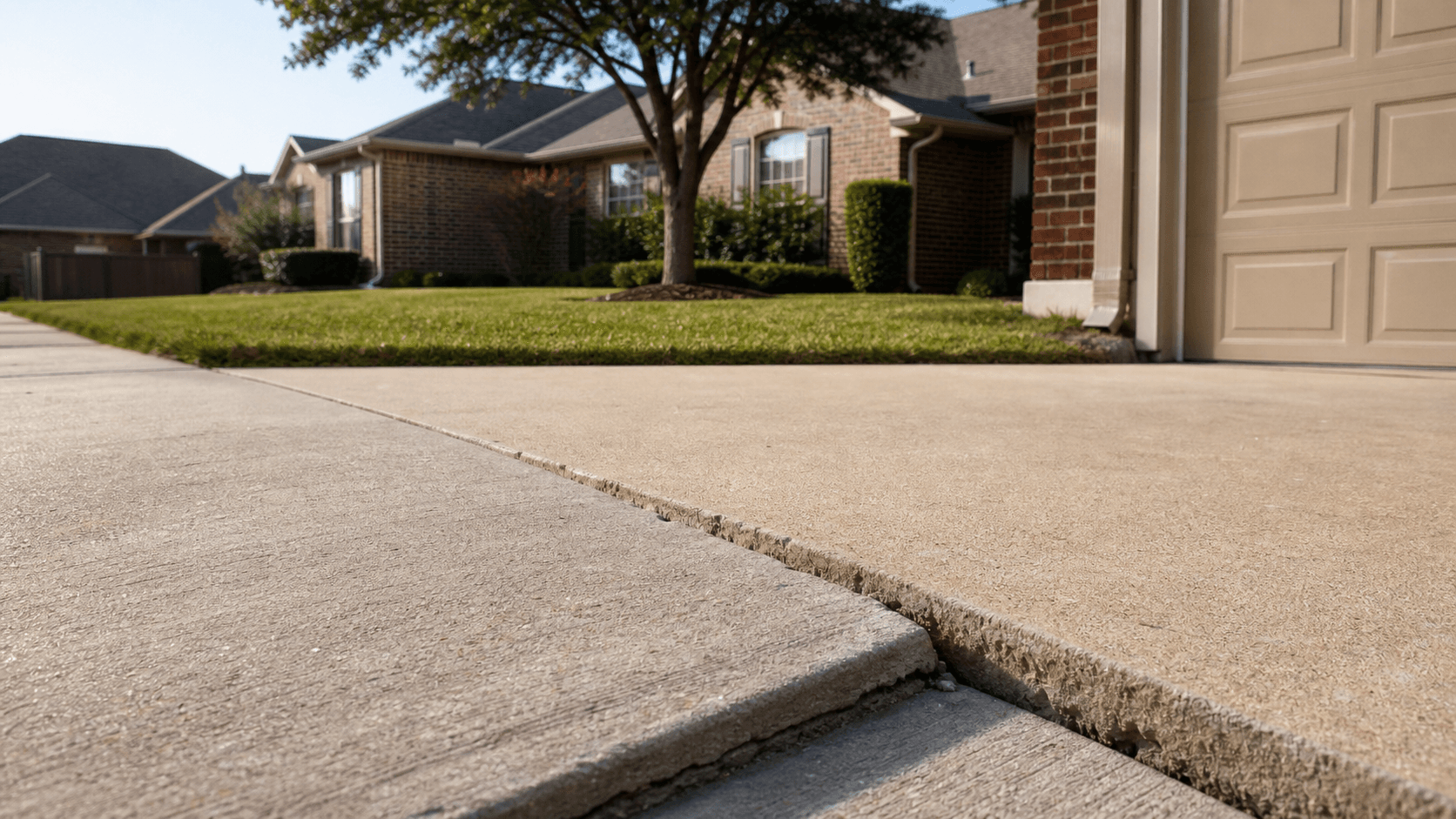
Driveway aprons dropping at the garage. The garage slab is part of the foundation; the driveway sits on grade. After 20-plus years on Houston Black, the driveway side has dropped enough that you feel a thunk at the apron when you pull in. This is the single most common Allen call.
Pool deck separation. A lot of Allen pools were installed in the 2000–2010 build window, when the inground pool became standard equipment in newer master-planned communities. The pool itself is a different engineered system than the deck around it, so the deck drops while the coping stays put. Lifting the deck back to the coping line is almost always the right call before water starts intruding under the deck.
Front walk and side-yard sidewalk drops. Long ribbon pours that cross multiple soil conditions tend to settle unevenly. We see this constantly along Bethany Drive subdivisions and in the neighborhoods west of US 75 where the original lots were graded across creek-adjacent terrain.
A/C and pool-equipment pad settling. Small flatwork around mechanical equipment carries little load, so it drops first when the clay shrinks. Tilted pads stress the line sets and condensate drainage. Easy lifts, often the first thing we do on a call.
Patio settlement at the house line. A back patio cold-jointed against the foundation will drift if it's settling. The slab is fine — the dirt under it isn't. We see this across the entire Allen housing stock, from late-1990s builds in Glendover Park and Country Meadow up through 2010s builds in Watters Creek and the Montgomery Farm area.
Garage floor drops near the overhead door. Less frequent than driveway-apron settlement, but it shows up on lots with deeper fill at the front. Polyjacking can usually fix this without removing what's stored on it.
The decision tree is the same one we apply everywhere: is the slab itself sound, or is it cracked through? If sound, lift it. If cracked through, talk about replacement.
What Concrete Leveling Costs in Allen
Most Allen jobs land between $400 and $3,000. Mudjacking quotes typically run $400 to $2,500 depending on slab area, lift height, and access. Polyurethane (polyjacking) usually runs $600 to $3,000 for the same scope. Full slab tear-out and replacement starts around $4,000 for small sections and runs past $15,000 for a full driveway with associated walkways.
The cost-to-protect calculation in Allen is favorable for lifting. Median home values in 75002 are $403,800, and most of the housing stock is in that 20–30 year band where the slabs are still structurally sound but the surrounding flatwork has accumulated visible settlement. Replacing serviceable concrete is rarely the right answer — the concrete didn't fail, the dirt under it moved. Lifting addresses the actual problem at a fraction of the replacement cost.
Median household income in this ZIP is $129,306, and 78% of the units are owner-occupied. That ownership profile changes the conversation: the people calling are typically planning to stay in the house and want a fix that holds, not a stopgap before they sell.
How Our Allen Partners Work
The process is the same everywhere we work, and it's deliberately unflashy.
On-site assessment. We come out, walk the property, measure the drop, and identify where the slab needs to be lifted to. We tell you whether it's a candidate for lifting, whether it needs partial removal and re-pour, or whether the slab is fine and the symptom is something else entirely.
Method selection. Polyurethane (polyjacking) is the default for residential Allen work — it's lighter, cures fast, and doesn't add hydrostatic load that the clay can later push back into the slab. Mudjacking is appropriate for very large slabs or scopes where the foam volume isn't economical.
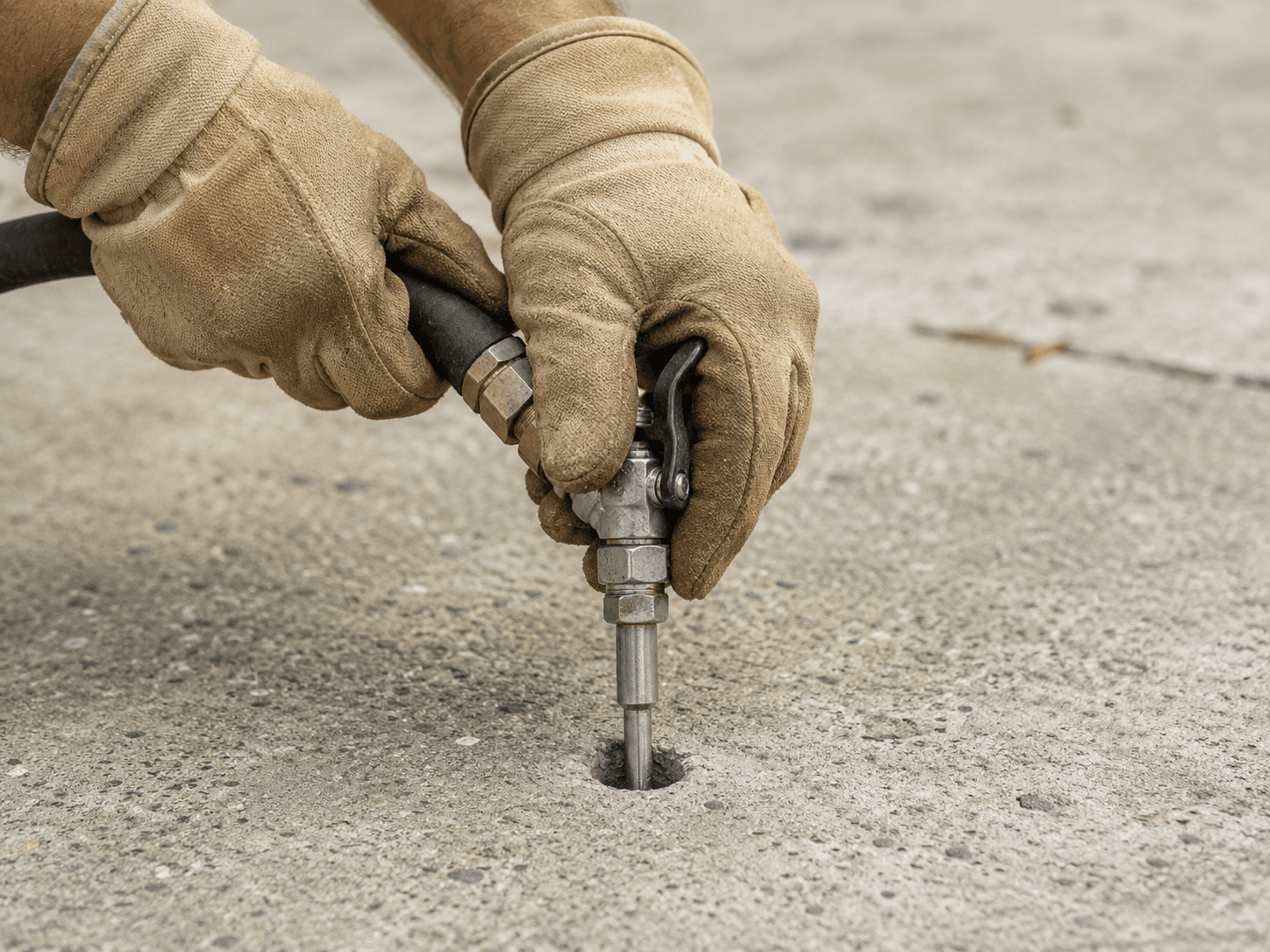
Drilling and injection. Small ports drilled in a calculated pattern. The technician injects in stages, watching the slab rise, and stops at the target elevation.
Cure and finish. Ports are patched. Polyurethane is structurally loaded within minutes; you can drive on it the same day in most cases. Cementitious slurry takes longer but still measured in hours.
We don't quote slab thicknesses or rebar specs we can't see. If you need a structural opinion on a slab we haven't lifted, we'll point you to a structural engineer.
Allen Neighborhoods We Serve
We work the entire Allen footprint — from the older sections south of Bethany Drive up through the master-planned communities along Stacy Road and the corridor west of US 75. The neighborhoods that show up in the open geographic record include Watters Creek, The Park At Montgomery Farm, Avondale, Country Meadow, Fall Creek, Fountain Park, Glendover Park, High Meadows, Oak Ridge, Quail Run, Saddle Ridge, Shaddock Park, Spring Meadow, and Walden Park Estates — a meaningful spread of mid-era and modern subdivisions across both sides of the city.
The largest single conversation we have in Allen tends to be in the Twin Creeks area — the master-planned community along Watters Road that was built out from the late 1990s through the early 2010s. That window matches the city's median-1999 housing stock almost exactly, so the typical Twin Creeks property has had 20-plus years of clay cycling under its driveway and pool deck. We get a steady stream of calls from there.
A piece of context that helps frame Allen's housing stock: the city only incorporated in 1953, and most of its modern footprint built up alongside US-75 once Central Expressway opened the corridor north of Dallas. That's why almost everything we work on sits in the post-1980 era — the city before that was a roughly 400-resident railroad stop on the Texas Traction Company's old interurban line that ran through here from 1908 to 1948. There are a handful of genuinely pre-war properties along the original tracks, but they're rare; if your home was built before 1980 in Allen, you're in a small minority of the housing stock and the slab under you was likely poured to a different standard than the post-tension monolithic pours that dominate everywhere else in the city.
The Watters Creek at Montgomery Farm corridor along Bethany Drive is the other reference point worth calling out. It's a mixed-use development with apartments, retail, and adjacent residential — the lot grading and drainage on the residential side reflect the broader site's drainage plan, not a stand-alone subdivision design. We see slightly different settlement patterns there than in the more conventionally-platted Twin Creeks lots a few minutes east.
If your address isn't in any of those named pockets, that doesn't change anything for us. The clay underneath doesn't know subdivision boundaries.
Allen Concrete Leveling FAQ
How much does concrete leveling cost in Allen? Most jobs run $400 to $3,000 depending on method, slab area, and access. We quote on-site after we've seen the work — phone numbers are guesses, and we'd rather give you a real one.
Is mudjacking or polyjacking better for Houston Black clay? For most Allen residential jobs, polyurethane is the default. It's lighter — it doesn't add weight that the swelling clay can then push back into your slab — and it cures fast enough that you can use the surface the same day. Mudjacking is still right for some larger or commercial slabs.
My house was built in 2000. Why is the patio dropping now? Twenty-plus years of wet-dry cycling on Houston Black is exactly when settlement-driven flatwork problems become visible. Modern post-1980 foundations are engineered to handle the clay; the surrounding flatwork was usually poured to a lighter spec and is on the same reactive subgrade. Year 20 is when that disparity catches up.
How long does the lift hold? A clean polyurethane lift on a sound slab typically holds for many years. The clay keeps cycling, but the foam is closed-cell and doesn't absorb water; it doesn't compress under residential loads. The lift fails early only when the underlying issue isn't really subgrade settlement — for example, a cracked slab moving along the crack instead of dropping uniformly. That's what the on-site assessment is for.
Can you lift a settled garage floor without moving everything off it? Usually yes. Polyjacking only needs small drill-port access on the slab surface; it works underneath. We've lifted garage floors with vehicles, shelving, and full storage in place.
What's the earliest visible warning sign on Allen slabs? A gap opening at the driveway-to-garage control joint is the most reliable early signal. Hairline cracks running diagonally from patio corners are the second. Once you can fit a quarter under any slab edge, you're firmly in the actionable range.
Will the lift affect my home's foundation? No. Flatwork lifting addresses concrete that sits on grade — driveways, sidewalks, patios, pool decks, A/C pads. It doesn't touch the foundation slab itself. If we suspect the foundation is involved, we'll tell you to bring in a foundation specialist; that's a different scope.
Do you cover the Watters Creek and Montgomery Farm areas? Yes. Those are some of the more common areas we work, along with Twin Creeks, Star Creek, and the older subdivisions south of Bethany. Whole-city footprint, not just one corridor.
Talk it through with someone who works Allen.
Describe what you're seeing — a crack, a sunken slab, a foundation question, a new pour. We'll tell you what it likely is and what it costs to fix.
Call (682) 254-4938