
A homeowner in a 2010-build subdivision who needs the driveway level by tomorrow morning, a pool deck that's separating from the coping and can't take any added weight, a garage floor settling under a tool chest the homeowner doesn't want to move — these are the calls that drive polyjacking volume. The method is newer than mudjacking, the materials cost more per job, and the equipment is smaller and quieter. None of which would matter if the result wasn't genuinely better in specific scenarios.
Call +1 (682) 254-4938 to find out if polyjacking is the right approach for your slab.
What polyjacking is (and what it isn't)
Polyjacking, also called polyurethane foam injection or polylift, pumps a two-part polyurethane resin under a settled slab through small ports drilled in the surface. The two components — typically a polyol resin and an isocyanate — meet at the injection gun, react chemically as they enter the void, and expand into a closed-cell foam that lifts the slab as it grows. Reaction begins within seconds. The foam reaches its design density quickly and continues curing to full structural strength over a window measured in minutes, not hours.
The cured foam is dimensionally stable, hydrophobic (it doesn't absorb water), and chemically inert at residential exposure levels. It doesn't break down under normal soil conditions, doesn't biodegrade, and doesn't shrink meaningfully after cure. The trade specification most foam manufacturers publish is a working compressive strength sufficient to support residential and light commercial slab loads, with the exact density chosen by the formulation used for the job.
What polyjacking is not: it isn't a structural foundation method. It lifts and supports slabs; it doesn't pier a settling house. It's also not a fix for severely cracked or structurally compromised slabs — if the concrete itself is broken past the point of holding together under its own weight, foam won't put it back together either. And foam is not a soil stabilizer. The cured mass underneath the slab is supporting the slab; it isn't reconditioning the clay around it.
The honest positioning: polyjacking is the right tool when slab weight matters (above-grade decks, foundation-adjacent flatwork), when fast return-to-service matters (driveways used daily), when access is constrained (back patios with no truck path), and when the homeowner wants smaller patches in the finished surface.
When polyjacking is the right call
Foam wins in these specific scenarios:
- Driveways the homeowner needs back the next morning — foam reaches structural strength within about 15 minutes; full cure is overnight; vehicle traffic in 24 hours is realistic, sometimes sooner.
- Pool decks settling away from the pool shell — added weight near a pool is a real concern with the bond beam and surrounding plumbing. Foam's lightweight fill lifts the deck without loading the pool's structural perimeter.
- Slabs adjacent to a residential foundation — when the flatwork is poured against the house and has tilted toward the foundation, slurry's added weight isn't always the right answer. Foam is the lower-load option in that geometry.
- Garage floors that need lifting without moving the contents — foam's port size is small enough that a careful crew can work around tool chests, cabinets, and parked vehicles in many cases.
- Tight-access patios and walkways — foam injection rigs are smaller and don't require a truck-mounted pump on site. A crew can work from a portable pump where a mudjacking truck couldn't reach.
- Sidewalk trip-hazard correction with same-day return to use — for commercial properties or HOA-managed walkways, foam's fast cure means the walkway is back in service before the next morning.
If two or more of those describe your situation, foam is almost certainly the better fit even at a higher per-job price.
What polyjacking costs
Polyurethane foam projects run more per job than mudjacking because the materials are more expensive per cubic foot and the equipment carries a higher capital cost that gets amortized into pricing.
Industry-typical residential polyjacking projects in DFW run $600 to $3,000 depending on the same four cost drivers as mudjacking:
- Square footage of slab — a single sunken section under a doorway threshold sits near the bottom of the range; a full driveway lift falls in the middle; a multi-section back-of-house project with patio plus pool deck approaches the top.
- Lift height required — small corrections need less foam volume; larger lifts need more material and more controlled passes.
- Void volume underneath — a slab that has lost a thin layer of subgrade is fast; a slab with a substantial cavity from years of consolidation needs significantly more foam.
- Access — foam's portability advantage shrinks the access cost vs. mudjacking, but it doesn't eliminate it. A back patio still requires getting line to the slab.
We don't quote polyjacking by phone. Until we walk the slab, see how it sits relative to its neighbors, and assess the void underneath, any phone number is a guess. The site assessment is free.
How polyjacking works (process)
A polyjacking crew arrives with a portable injection rig, the resin and isocyanate drums, and the heated supply lines that keep the components at reaction temperature. Setup runs 20 to 30 minutes. The lead operator maps port locations based on the lift pattern needed — typically a denser grid in low spots, lighter where the slab is closer to grade.
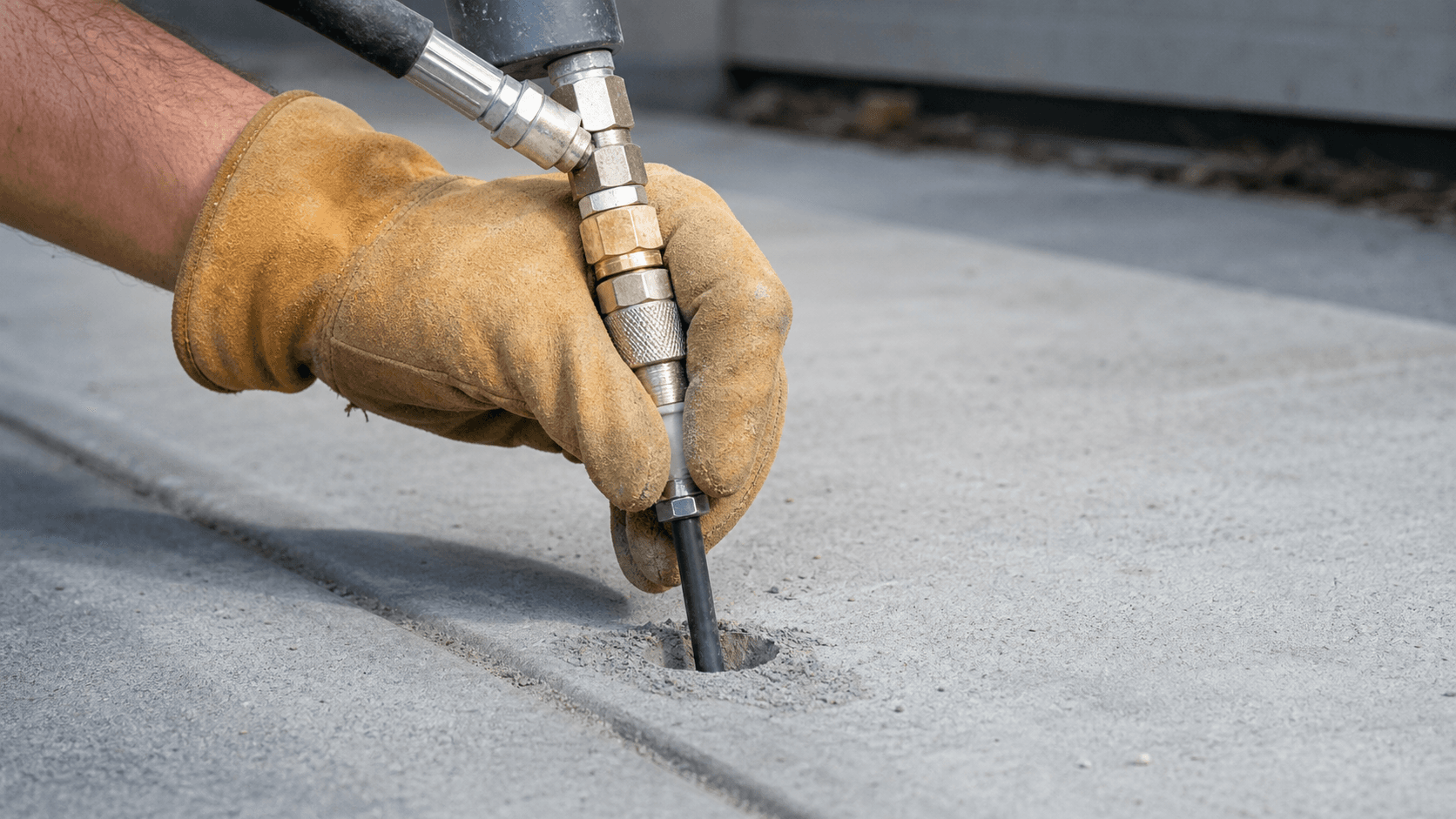
Ports are drilled through the slab — typically about five-eighths of an inch across, much smaller than a mudjacking port. The injection gun seats into each port, the operator pulls the trigger, and the two components meet at the nozzle and begin reacting as they enter the void. Foam expansion is visible at the slab's edge within seconds; the lift response is fast enough that the operator paces injection in short pulses, watching the laser or string-line reference between bursts.
The foam reaches structural strength within about 15 minutes of injection. Full cure to working hardness happens overnight. Vehicle traffic is typically fine within 24 hours, depending on temperature; foot traffic is fine within an hour or two of the last injection. Cold weather extends those windows because the chemistry runs slower in low ambient temperatures.
After the lift, ports are filled with backer rod and a concrete grout color-matched to the slab. The patches are roughly the diameter of a pencil and weather to near-invisible within a few months.
When polyjacking is NOT the right answer
Foam isn't the right method on every slab.
If the slab is severely cracked or structurally compromised, foam injection can in some cases worsen the cracking pattern as expansion forces look for the path of least resistance. The honest answer is replacement, not lifting.
If the lift required is small and the homeowner's primary criterion is lowest possible cost, mudjacking will usually come in several hundred dollars cheaper for the same result.
If the slab is part of a load-bearing foundation rather than flatwork extending off it, foam is not a foundation-repair method — that work needs structural piers, not void filling.
And if the soil underneath is saturated and unstable from a recent plumbing leak or drainage failure, lifting before the soil stabilizes will lift the slab today and watch it move again in a season. Honest sequencing: address the water source first, give the soil time to recondition, then lift.
Polyjacking FAQ
How long until I can drive on it? Typically 24 hours after the last injection. In warm conditions, sooner; in cold weather, longer. Foot traffic is fine within an hour or two.
Does the foam break down over time? No. Cured polyurethane foam is dimensionally stable, hydrophobic, and chemically inert at residential soil exposure. It doesn't biodegrade in the ground.
What temperature does foam need? The chemistry is temperature-sensitive on both ends. The supply lines are heated to keep the components at reaction temperature. Cold ambient slows cure; very hot ambient can accelerate it past the operator's comfort window. Most DFW conditions are fine year-round; we adjust for extremes.
Will the foam expand and crack my slab? A controlled injection puts very little stress on the slab. The risk is uncontrolled injection — too much volume at one port — and that's an experience problem.
How small are the drill holes? Roughly five-eighths of an inch across, patched flush after the lift. Much smaller than mudjacking ports.
Is foam injection better than mudjacking? Better for some scenarios, not all. Foam wins on weight, cure speed, and tight access. Mudjacking wins on cost and on heavy slabs with large voids to fill. The right method depends on the slab.
Is the foam safe around plants, pets, and water lines? Cured foam is inert. The injection process doesn't introduce material to surrounding soil at distance from the slab; the chemistry contains and cures within the void. Pool water, irrigation lines, and landscaping aren't at risk from a properly executed job.