
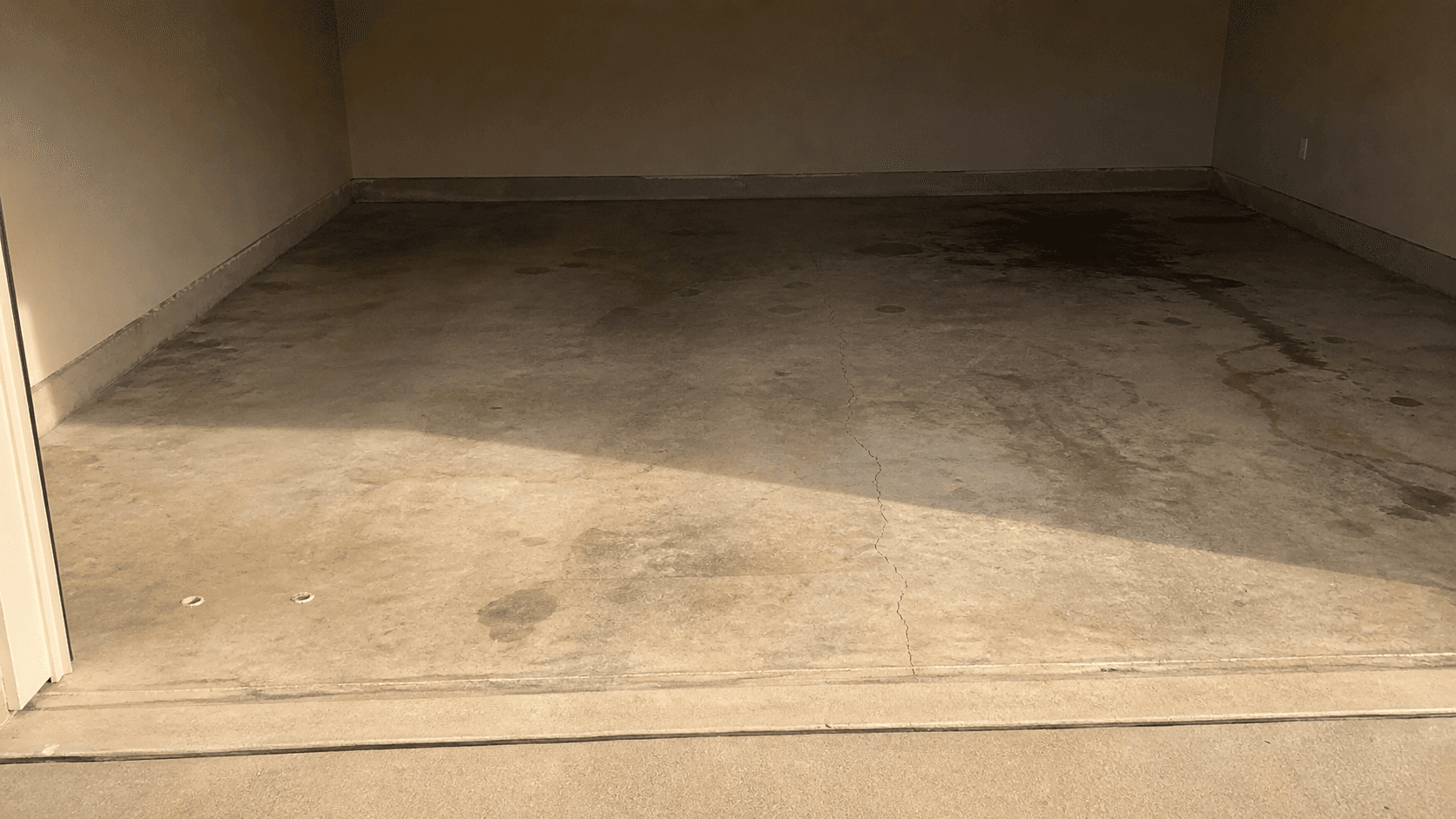
A garage floor that's dropped is one of the more frustrating slab problems a homeowner runs into. The garage is full — tools, cabinets, vehicles, the storage that always ends up in there — and the obvious symptoms (a tilted workbench, water running the wrong way after a rain, the door not seating against the threshold) all point to a problem that feels like it requires the contents to come out before the work can begin. It usually doesn't. Most garage floor leveling jobs in DFW are done with the homeowner's stuff still in place.
Call +1 (682) 254-4938 to describe what your garage floor is doing.
What garage floor leveling is (and what it isn't)
Garage floor leveling is the targeted application of slab-lifting methods — usually polyurethane foam injection — to interior garage slabs that have settled below their original grade. The work happens through small ports drilled in the slab surface; foam is injected; the slab lifts as the foam expands; the ports are patched; the homeowner walks away with a level garage floor and a new appreciation for how much storage they accumulated against the back wall.
Polyjacking is the standard approach for interior garage work for two reasons: foam is lightweight (so it doesn't add load to a slab that may be sitting on already-stressed subgrade), and the injection rig is portable enough to maneuver around tools, cabinets, and parked vehicles without requiring the homeowner to clear the space. Mudjacking can work in a garage when access permits, but the larger ports and the truck-line setup are usually less practical than foam in an enclosed interior.
What garage floor leveling is not: it isn't a fix for a structurally damaged slab. If the garage floor has cracked through under heavy loading or settled past the point where the slab itself has bent and broken, leveling won't restore it; replacement is the honest answer. It's also not foundation repair. The garage floor sits on its own slab pour, separate from the home's foundation in most residential builds, so settling here doesn't necessarily mean the house has a structural problem — though it can be an early signal worth checking.
When garage floor leveling is the right call
The classic garage floor settlement pattern in DFW: the slab has dropped along the front (street-facing) wall, where the door threshold sits, and possibly along the wall shared with the house. The drop creates a few specific symptoms:
- The garage door no longer seals against the threshold — gaps appear at one or both corners where the seal used to make contact, and water, leaves, and bugs find their way in.
- Water running the wrong direction after a rain — a properly graded garage floor slopes slightly toward the door so water runs out. A settled floor inverts that slope and pools water against the back wall or, worse, against the house wall.
- The slab is visibly lower than the driveway it meets — there's a noticeable lip at the threshold where the garage floor used to sit flush with the apron and now sits below it.
- A tilted workbench, leaning storage shelves, or a refrigerator running unevenly — interior fittings in the garage are an early indicator that the floor is no longer level.
- Cracks at the slab-to-foundation joint — where the garage floor meets the home's foundation wall, settlement opens up a gap or crack that wasn't there before.
- Pooling at floor drains that no longer drain — if your garage has a floor drain and it's now sitting at a high point rather than a low point, the slope has flipped.
If you're seeing two or more of these together, lifting is almost certainly the right next step.
What garage floor leveling costs
Industry-typical residential garage floor leveling in DFW runs $700 to $2,500 depending on the same factors that drive any leveling job: square footage being lifted, lift height required, void volume underneath, and access.
A typical scope of work — lifting the front portion of a two-car garage where the slab has dropped near the door — sits in the middle of that range. A small targeted lift (one corner near the threshold) comes in at the low end. A multi-bay garage or a larger pour with substantial settlement runs higher.
We don't quote garage work by phone. Until we walk the floor, see how it sits relative to the apron and the foundation wall, and probe the joint conditions, the number is a guess. Site visit is free.
How garage floor leveling works (process)
A typical garage lift runs three to five hours depending on scope. The crew arrives with the portable foam injection rig, which can usually fit through the open garage door without any setup outside. The lead operator walks the floor with the homeowner, marks port locations on the floor based on the lift pattern needed, and runs a level line as a reference for the work.
Ports are drilled through the slab — small enough that the patches afterward are nearly invisible against most garage finishes. The injection gun seats into each port, the operator pulls the trigger, and the two-component foam reacts in the void underneath the slab. The lift response is fast — within seconds, the operator can see the slab moving toward grade — and the work proceeds port by port until the floor is back where it should be.
If the homeowner has tools, a workbench, or vehicles in the garage, the crew works around them in most cases. Heavy permanent fixtures attached to the slab itself (tool boxes bolted down, fixed cabinetry running the back wall) sometimes need to be addressed before drilling the ports immediately underneath them, but generally the contents stay where they are.
Cure happens fast. Foot traffic is fine within the hour. Vehicle traffic is typically fine within 24 hours, depending on temperature. The homeowner can usually pull the cars back in the next day.
When garage floor leveling is NOT the right answer
A few scenarios where lifting is the wrong move.
If the slab is structurally compromised — heavy through-cracking under the door area, a slab that has bent under its own weight or under heavy load, exposed and corroded rebar — replacement is the answer. Lifting a broken slab can break it further.
If the settlement is part of a broader foundation problem — the home itself is showing structural symptoms (sticking doors, diagonal interior cracks, gaps in trim) and the garage floor is just one symptom among many — then lifting the garage floor without addressing the underlying foundation issue is treating a downstream symptom and leaving the cause in place.
If the garage floor was poured against active fill that hasn't fully consolidated (this happens on newer construction where the build schedule didn't allow for full settlement of the pad before the slab was poured), early-stage settlement is sometimes still in motion. Lifting once the soil is stable beats lifting twice.
And if a slab leak under the garage has washed out subgrade, the leak repair has to come first. Lifting on saturated, washed-out soil is short-lived work.
Garage floor leveling FAQ
Do I need to empty the garage before the work? In most cases, no. The crew works around tools, cabinets, and vehicles. Permanent fixtures attached to the slab sometimes need to be addressed locally.
How long does the work take? Typically three to five hours. The homeowner is usually back parking in the garage the next day.
Will the patches show? The drill ports are small. Patches are color-matched and weather to near-invisible against most garage finishes.
Why does my garage floor sink near the door? The front of the garage sits over the most heavily disturbed soil from the original construction — that's where the trench and the apron were poured, and the fill there was disturbed last. Combined with vehicle loads at the threshold, it's the most common settlement zone.
Will lifting the garage floor crack my foundation? A controlled lift puts very little stress on the floor or the adjacent foundation wall. The risk is uncontrolled injection, which is an experience problem, not a method problem.
Can mudjacking work in a garage instead of foam? Sometimes. The truck-line access to an interior garage is harder than to a driveway, and the larger drill ports show more in a finished garage floor. Foam is the more typical choice for these reasons.
How long will the lift hold? A correctly executed lift on stable subgrade typically holds 8-10 years or more. The variable is whether soil conditions stay stable.