
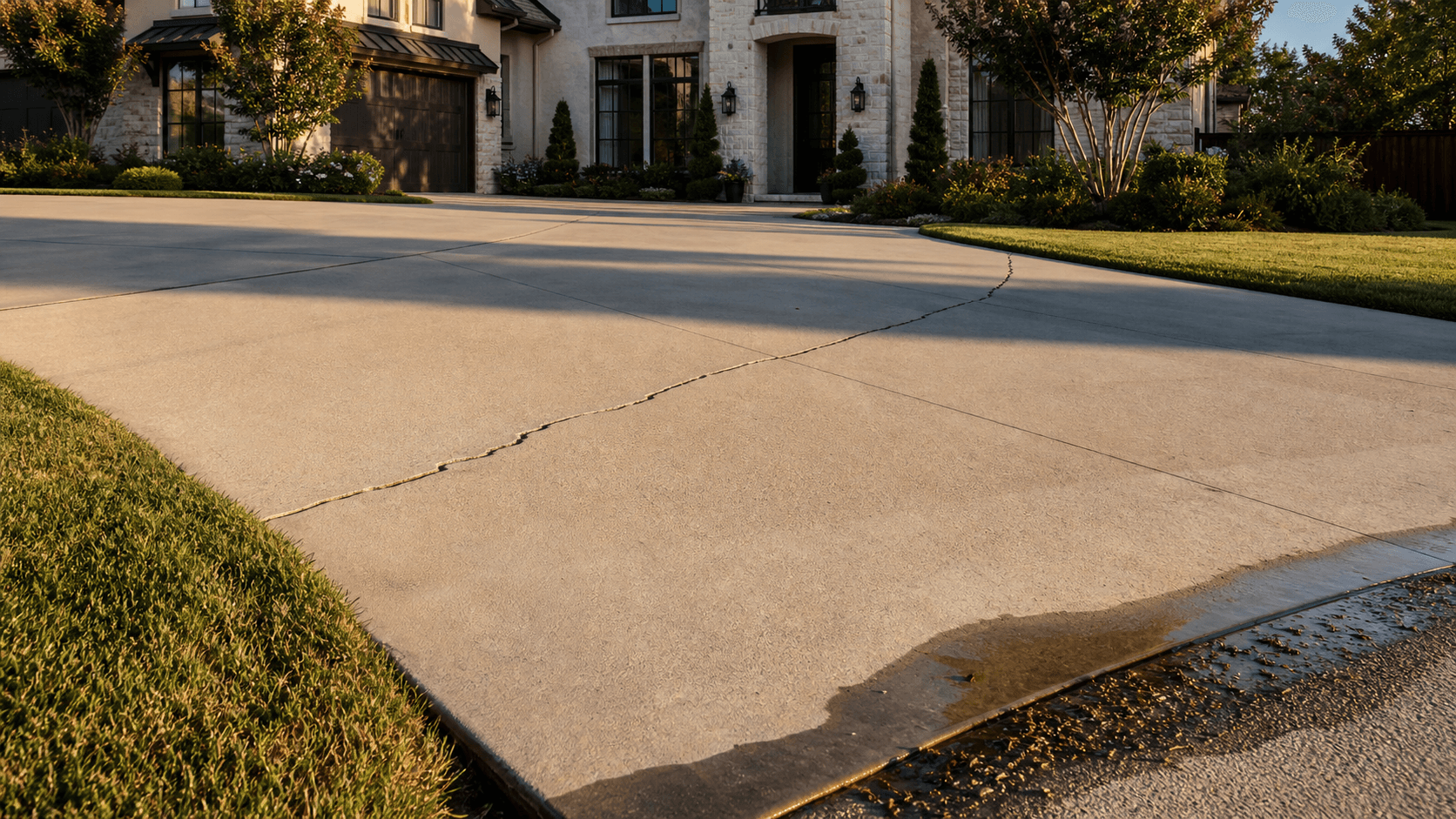
If you're seeing settlement, cracking, or a slab that's pulling away from the house, call us to walk the property and tell you what's actually under it.
Why Frisco Concrete Is Different
The dominant soil at Frisco's seed location is the Stephen series, making up 85% of the mapped unit there. Linear extensibility is 4.5% — the percentage of volume change between fully wet and fully dry. That's the "moderate" shrink-swell bucket, three classes lower than the "very high" rating that defines Houston Black markets like Allen, Plano, McKinney, and Richardson. The clay fraction is smaller, and what clay is there is sitting on a layer of weathered chalk that starts at roughly 39 centimeters below the surface.
That bedrock depth is the variable that defines Frisco. Most North Texas residential slabs are designed against a no-bedrock soil profile — the assumption is that the foundation can flex with the upper soil column. When bedrock sits 39 cm down, that assumption stops holding. Two things happen instead.
First, water has nowhere to go vertically. Rain that would normally infiltrate down through deep clay hits the chalk and moves laterally — along the bedrock surface, under your slab, looking for an exit. That's why Frisco concrete failures are often drainage-driven instead of swell-driven: a slab that's settling because water has channelized underneath and washed out fines, not because the clay shrunk.
Second, the smaller clay fraction does still shrink and swell. Even at 4.5% linear extensibility, when the clay layer over the chalk dries out in August it pulls back; when it rebounds in May it pushes up. The motion is smaller than what Houston Black does, but it's not zero, and it concentrates at the soil-bedrock interface where the clay can't move down — only up.
Drought is the third variable. At least a quarter of Collin County sat at D1 (moderate drought) or worse for 14 of the last 53 weeks — about a quarter of the year. There's been no D2 event in this window. But on a thin clay column over chalk, even D1 dries the soil meaningfully, because there isn't deep clay to draw moisture from. Annual precipitation runs 36.1 inches, with May the wettest month and August the driest, and July averaging 95.6°F highs. The wet-dry swing on a thin profile concentrates at the surface — exactly where your concrete sits.
The fourth variable is the housing stock. Frisco's 75034 ZIP has a median year built of 2010, putting it firmly in the modern bucket. Most of these slabs are post-tension and were poured to current standards. They're not failing the way 1974 Richardson slabs are failing. What we see in Frisco is more often new-build flatwork that's settled within its first decade because of subgrade washout or differential drainage rather than long-term clay cycling.
Common Scenarios on Frisco Slabs
Calls we field in Frisco cluster around drainage-driven and bedrock-related failures more than the swell-driven failures we see elsewhere.
Driveway sections that have settled with a clear water path. When you see a settled driveway in Frisco, the first thing we look for is the drainage. Often there's a downspout, a gutter discharge, or a slope that's been routing water along the same line for years. The water hits the chalk, runs along it under the slab, and washes out the fines. The slab follows.
Pool decks settling around skimmer side. Pools in Phillips Creek Ranch, Newman Village, and Starwood — the higher-end west Frisco communities — are often built with the deck poured directly against the coping. When the deck settles, it's almost always on the side where the splash and overflow water has been running off for years. The chalk doesn't care; the clay over it does.
Patio sections separating from the house. A back patio cold-jointed against a Frisco foundation will drift if water has been routing along the foundation line. The patio is on grade, the foundation is engineered against the bedrock, so the patio drops while the house stays put.
Sidewalks that have heaved at one joint and dropped at the next. This is a Frisco-specific symptom we see less often elsewhere. With a thin clay layer over hard chalk, differential motion at control joints can produce both lift and drop on the same ribbon — heave on the side where moisture is accumulating, drop on the side where water has channelized.
A/C and pool-equipment pads tilted toward the house. The smaller the pad, the more vulnerable to local drainage problems. We see these constantly — tilting, settling, condensate lines running back toward the foundation.
Garage floor settling at the overhead door. Less common in Frisco than driveway settlement, but when it happens it's usually because the front of the lot has worse drainage than the back, and water has been working at the apron for a decade.
The diagnostic question in Frisco is different from the rest of our service area. In Allen or McKinney, we ask: how much has the clay moved? In Frisco, we ask: where is the water going, and what has it carried out from under the slab?
What Concrete Leveling Costs in Frisco
Frisco quotes typically run $400 to $3,000, the same range we see across the metroplex, but the distribution is shifted. More Frisco jobs end up on the higher end of the range because of two factors: larger lot sizes in the master-planned communities (more square footage of flatwork), and the need for drainage corrections that go beyond the lift itself.
Mudjacking on Stephen-series soil works fine, but polyurethane (polyjacking) is usually the better call because the foam doesn't add water-soluble mass that a future drainage event could erode out from under the slab again. Closed-cell polyurethane stays put.
Full slab tear-out and replacement starts around $4,000 for a small section and runs past $15,000 for a full driveway. With Frisco's median home value at $679,500 — the highest in our service area, and roughly 60% above Richardson's — the cost-to-protect math leans even harder toward lifting when the slab is structurally sound. Replacing serviceable concrete on a $700K property because the dirt under it moved is rarely the right answer; addressing the drainage issue and lifting the slab back to grade usually is.
The owner-occupancy rate in 75034 is 40.2%, and median household income is $107,945. The lower owner-occupancy means a meaningful share of the calls we field come from property managers and HOAs, especially in the townhome and condo developments along Lebanon Road and the Dallas North Tollway corridor.
How Our Frisco Partners Work
The process is the same we use everywhere, with one Frisco-specific addition.
On-site assessment, with a drainage walk. We measure the drop, but we also walk the lot and look at where water is going — downspouts, splash blocks, gutter discharge points, slope away from foundation, any visible erosion lines. On Stephen-series soil over chalk, ignoring the drainage and lifting the slab anyway is a temporary fix. We try not to do that.
Method selection. Polyurethane is the default for residential Frisco work because of the closed-cell, water-resistant property. Mudjacking is appropriate for some larger commercial slabs.
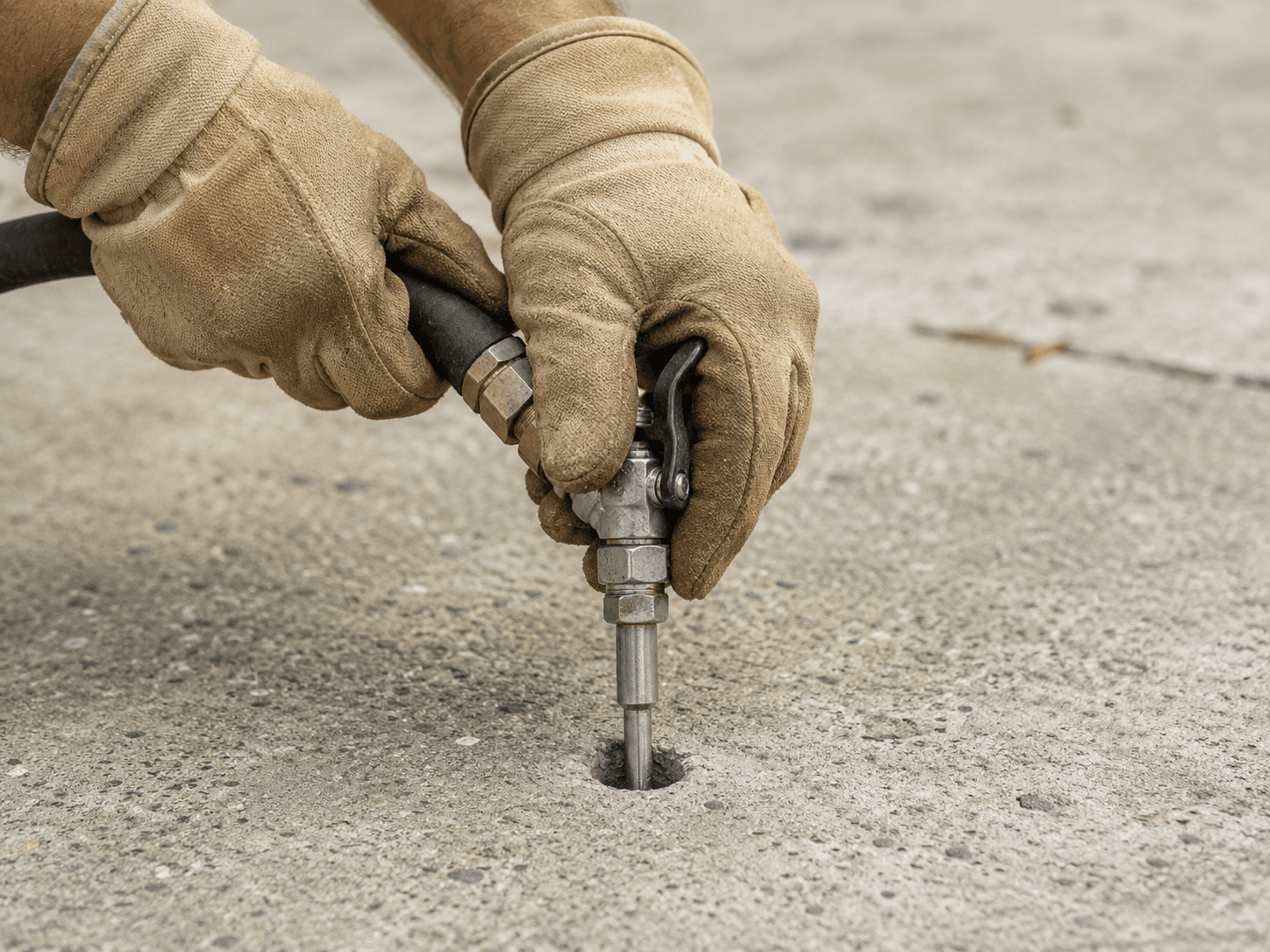
Drilling and injection. Small ports, calculated pattern, staged lift to target elevation.
Cure and finish. Ports patched, walk-on within hours for polyurethane.
Drainage recommendations. If we identify a contributing drainage issue, we'll tell you what we'd fix and roughly what it costs — even if it's outside our scope. A re-routed downspout that addresses the root cause is a better investment than a second lift in three years.
We don't quote slab thickness, rebar, or PSI specs we can't verify. Structural opinions on a slab we haven't lifted go to a structural engineer.
Frisco Neighborhoods We Serve
We work the entire Frisco footprint, west of US 75 across the Dallas North Tollway and Preston Road corridors and out to FM 423 / Eldorado Parkway. The OSM open geographic record returns four named neighborhoods inside the Frisco city boundary: Emerson Estates, Firefly, Liberty Crossing, and The Grove Frisco — a reasonable spread across the eastern and central parts of the city.
The largest concentration of calls we get tends to be in the master-planned communities along the Dallas North Tollway corridor: Phillips Creek Ranch (west Frisco, near Stonebrook Parkway and Lebanon Road), Newman Village (a gated 400-acre luxury master-planned community established in 2008, with European- and Mediterranean-influenced custom homes off Eldorado Parkway and west of Legacy Drive), and Starwood (gated, off the Dallas North Tollway and Lebanon Road, with mature trees and stone walls). Those three communities together represent a meaningful share of the higher-value flatwork in the city — large pool decks, long driveways, extensive patios — and the kind of properties where lifting consistently beats replacement on cost.
The Dallas North Tollway corridor is also where Frisco's two highest-profile mixed-use anchors sit. Frisco Square, the city's master-planned downtown around the George A. Purefoy Municipal Center, opened in September 2006 and now spans roughly 147 acres of office, retail, and multi-family use; the flatwork in that footprint is a mix of municipal, commercial, and residential pours all on the same Stephen-series profile, and we get HOA-routed calls from the rental residential side of it. The Star — the Dallas Cowboys' 91-acre world headquarters and practice facility along the Tollway near Warren Parkway — opened in 2015 as part of what local press calls the "$5 Billion Mile," and the surrounding corporate / residential build-out from that era is the most concentrated pocket of post-2015 flatwork in the city. Pool-deck and patio calls in those newer communities are typically less than ten years out from the original pour, which means they're early in their drainage-driven settlement curve rather than the long-arc clay cycle.
We also cover the older sections south of Main Street and the corridor along Eldorado Parkway between the Dallas North Tollway and Preston Road. Frisco is large enough that no single contractor sees every neighborhood every week; the principle is the same everywhere — Stephen-series soil over shallow chalk, drainage-driven settlement, modern slabs that respond well to polyurethane lifting.
Frisco Concrete Leveling FAQ
How much does concrete leveling cost in Frisco? Most jobs run $400 to $3,000. Frisco quotes tend to come in toward the higher end because of larger lot footprints and the frequency of drainage work that should be done at the same time. We quote on-site after we've seen the property.
Is the soil in Frisco really different from the rest of DFW? At our seed-point query, yes. The dominant soil series in Frisco is Stephen — a thin silty-clay over chalk bedrock at about 39 cm — with moderate (not very high) shrink-swell. Most of the rest of Collin County is Houston Black at very high shrink-swell. That changes the dominant failure mode from clay swelling to drainage-driven washout.
Does that mean I don't have to worry about my slab? No — it means the failure mode is different, not absent. Stephen-series soil still moves with moisture (just less), and the shallow bedrock concentrates drainage problems under the slab. Most of what we lift in Frisco is settlement caused by water channeling along the bedrock surface, not clay swelling.
Mudjacking or polyjacking on Stephen-series soil? Polyurethane is usually the better call. The closed-cell foam doesn't dissolve or wash out, which matters in a soil profile where water tends to move laterally along the bedrock surface. Mudjacking can still work but is more vulnerable to a future drainage event.
My house was built in 2010. Why is the patio settling? A decade and a half of seasonal drying, drainage routing, and the May-August precipitation swing is enough time to wash fines out from under flatwork on a thin Stephen-series profile. Modern post-tension foundations are engineered against this — the surrounding flatwork usually isn't.
Can lifting fix a slab that's cracked through? Lifting can only re-support a slab that's structurally sound. If the concrete itself is cracked through, lifting isn't the right scope — you're looking at partial removal and re-pour, or full replacement. We tell you which one on the on-site visit.
Will fixing the drainage make the lift last longer? Yes, meaningfully. On Stephen-series soil with shallow bedrock, the lift addresses the symptom; the drainage fix addresses the cause. We'll point out drainage issues whether or not we're the ones fixing them.
Do you work in Phillips Creek Ranch and Newman Village? Yes. Those are some of the higher-volume calls we get in west Frisco, along with Starwood and the master-planned communities along Lebanon Road. Whole-city footprint, not just the corridor along the Dallas North Tollway.
Is the lift covered by HOA or community association rules? Most of the master-planned Frisco communities have aesthetic guidelines that govern visible work — paint colors, driveway extensions, deck materials. A polyurethane lift typically falls below that threshold because it's not visible after the ports are patched. We can pull the relevant HOA documents on request, but in our experience this is rarely an issue.
Talk it through with someone who works Frisco.
Describe what you're seeing — a crack, a sunken slab, a foundation question, a new pour. We'll tell you what it likely is and what it costs to fix.
Call (682) 254-4938