
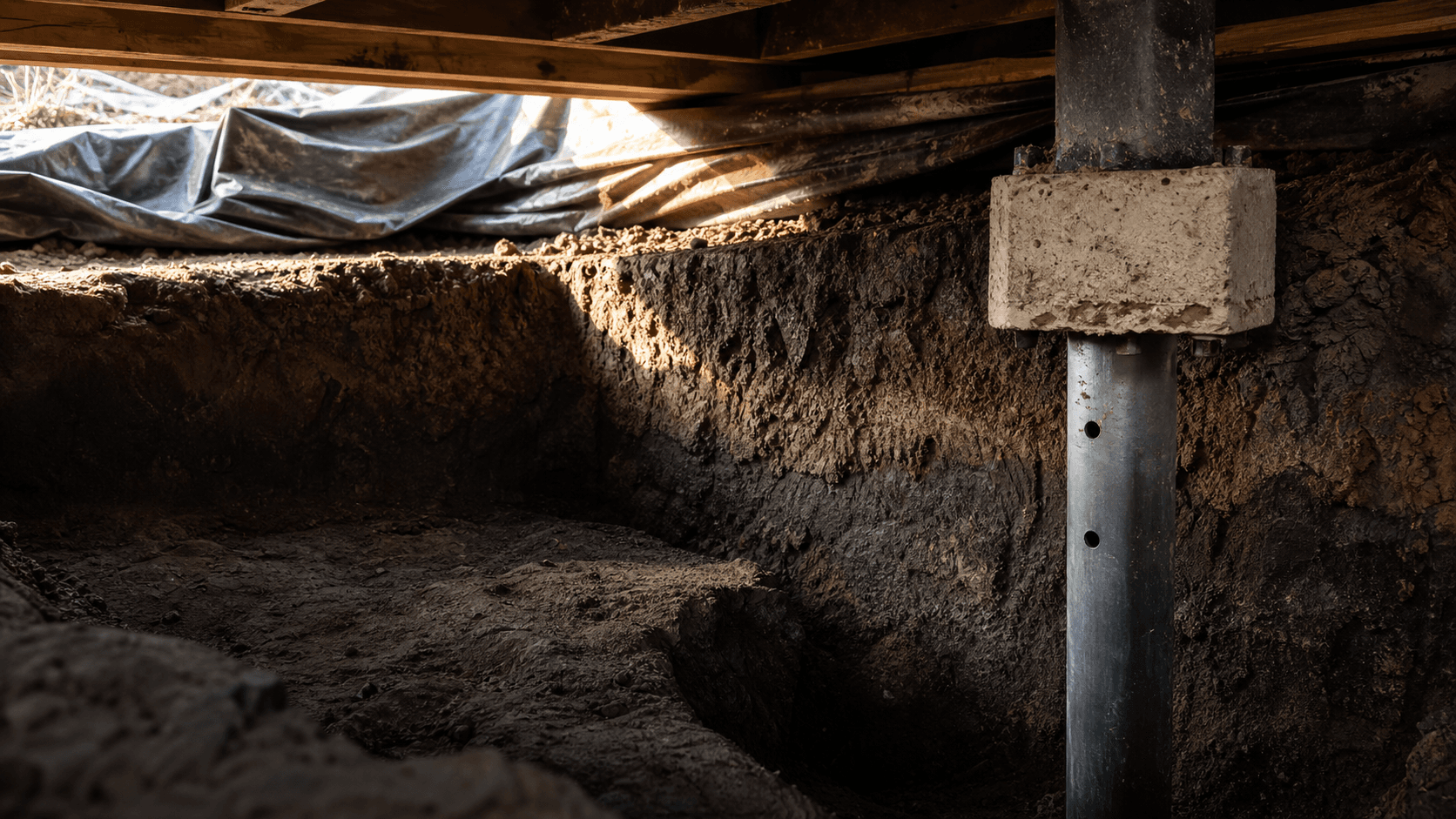
Foundation repair is a different category from concrete leveling, and confusing the two is one of the most common — and most expensive — mistakes a homeowner can make. Concrete leveling lifts flatwork: driveways, patios, sidewalks, garage floors. Foundation repair stabilizes the house itself: the slab the home sits on, the piers underneath it, the drainage that keeps soil from cycling under the perimeter. Different scope, different equipment, different licensing, different cost class.
Call +1 (682) 254-4938 to describe what your house is doing. If it's foundation work, we'll tell you that, and we work with licensed structural specialists for the actual installation.
What foundation repair is (and what it isn't)
Foundation repair is the structural work that stabilizes a settling or shifting home foundation. In DFW, where most homes are built on monolithic concrete slabs over reactive clay soil, foundation repair almost always means installing piers — vertical structural members driven or drilled into the soil deep enough to reach a stable bearing layer — and transferring the load of the home from the moving surface clay onto those piers. The four main pier types:
- Pressed concrete piles — pre-cast concrete cylinders pressed hydraulically into the soil one stacked segment at a time using the weight of the house as the reaction force. The traditional residential method in DFW; well-understood, widely-used, and the lowest cost per pier among engineered options.
- Pressed steel pipe piles — similar installation method, steel pipe instead of concrete cylinders. Used where deeper installation is needed or where soil conditions don't allow concrete to seat cleanly. Higher cost per pier than concrete.
- Helical piers — steel shafts with helical bearing plates, advanced into the soil by torque rather than pressure. The torque-to-capacity correlation gives engineers a measured load-bearing reading on every pier. Used where a measurable bearing capacity is required and on commercial work. Highest cost per pier of the three.
- Drilled concrete piers — large-diameter concrete piers cast in place in pre-drilled shafts. More common on new construction and major foundation rebuilds than on residential repair work, but used where loads are heavy and depth requirements are substantial.
Foundation repair also includes the supporting work that addresses the cause of the movement, not just the symptom: drainage corrections, root barriers, soaker-hose installation around the perimeter, and grading adjustments that keep soil moisture stable.
What foundation repair is not: it isn't slab leveling. If your driveway has dropped, your patio has tilted, or your sidewalk has a trip hazard, that's flatwork, and it's a different scope at a fraction of the cost. It's also not a cosmetic fix for cracked drywall or sticking doors — it's the structural intervention that addresses the soil and bearing problem causing those symptoms.
When foundation repair is the right call
Specific scenarios that point to structural work rather than slab leveling:
- Diagonal cracks running from window or door corners — the classic signature of differential settlement in a slab-on-grade home. The crack pattern follows the path of internal stress as one corner of the home settles relative to another.
- Doors and windows sticking seasonally and getting worse year over year — a small amount of seasonal door sticking from clay cycling is normal in DFW. A door that's sticking worse each summer than the last is moving with progressive foundation displacement.
- Visible gaps between trim and ceiling, or between cabinetry and walls — interior finishes are designed to a tight tolerance and don't move on their own. Gaps appearing where there weren't any are a foundation signal.
- Brick or stone exterior cracks following a stairstep pattern — masonry cracks running diagonally up through the mortar joints in a stairstep are one of the most reliable visual signals of foundation movement.
- Floors that are visibly out of level — a marble that rolls predictably to one corner of a room across multiple rooms is showing you the differential settlement profile of the slab.
- Plumbing leaks under the slab — a slab leak from a corroded supply or drain line washes out subgrade, which accelerates differential settlement. The plumbing fix and the foundation work are often a combined scope.
If you're seeing two or more of these together, the next step is a structural diagnosis, not a flatwork lift.
What foundation repair costs
Foundation repair runs at a different cost class from concrete leveling because the scope, equipment, engineering, and risk profile are all different.
Industry-typical residential foundation repair in DFW falls in the range of $4,000 to $15,000 or more, depending on:
- Number of piers required — the structural assessment determines how many piers are needed and where. A few piers along one settled corner is the low end; a full-perimeter pier installation is the high end.
- Pier type — pressed concrete is the most economical, helical piers the most expensive, with steel pipe in between.
- Depth required — soil conditions determine how deep piers need to be driven to reach competent bearing. Deeper installations cost more.
- Access and finished landscaping — installation requires excavation around the perimeter. Mature plantings, hardscape, and tight access add labor and restoration time.
- Drainage and grading work — addressing the cause typically adds soaker-hose systems, root barriers, or grading work that runs as separate line items.
The full-perimeter major repair in the upper range is rare on a healthy home; the more common scope is a partial intervention on the corner or wall showing symptoms. We don't quote foundation repair by phone — and the structural specialists we work with don't either. The diagnosis happens on-site.
How foundation repair works (process)
A typical pier installation runs one to three days per scope, depending on number of piers and access conditions.
The diagnosis phase comes first. A structural specialist walks the home, takes elevation readings across the slab with a manometer or laser, maps the differential profile, and determines where piers need to go. The recommendation comes back as a pier plan — number, type, location, and depth target — sometimes with an engineer's stamp depending on jurisdiction and scope.
Installation requires excavating a small pit at each pier location along the home's perimeter — typically a couple of feet deep and wide enough to set the equipment. For pressed concrete piles, a hydraulic ram seats against the home's footing and presses pre-cast cylinders into the soil one at a time, stacking them as each segment seats. Installation continues until the load-bearing reading meets the target. For helical piers, a torque motor advances the helical shaft into the soil while monitoring torque-to-capacity correlation. Once installed, a bracket connects each pier to the home's footing, and a controlled lift returns the affected portion of the slab toward level.
After the structural work, soil and grade are restored, and any drainage corrections are installed: soaker hoses to keep perimeter soil moisture stable, root barriers where mature trees are pulling moisture from under the slab, grading where surface water has been running toward the foundation rather than away.
Cure and settlement window: the home should not see meaningful structural movement on a properly engineered installation, but the soil around the piers continues to recondition for some weeks afterward.
When foundation repair is NOT the right answer
Some symptoms read like foundation problems but aren't.
If your driveway, patio, or sidewalk has settled but the house itself hasn't moved, that's flatwork — concrete leveling, not foundation repair. The cost difference is meaningful: a slab lift is hundreds to low thousands; a foundation repair is thousands to many thousands.
If interior cracking is purely cosmetic — small drywall hairlines that haven't widened over time, paint cracks at corners that show every winter and close every summer — that may just be normal wood-frame movement, not structural settlement.
If a manometer reading shows the slab is within tolerance — typical thresholds for residential intervention are differential measurements that exceed common industry guidelines, and many homes that look like they have foundation problems are actually within tolerance — then watching and addressing drainage may be the right answer rather than installing piers.
And if the soil underneath is in active flux from a current plumbing leak or major drainage failure, fixing that source before any pier work is the honest sequence. Piers in unstable soil are a setup for revisiting the work.
Foundation repair FAQ
How do I know if I need piers? A structural assessment with elevation readings is the only reliable answer. Visible symptoms (door sticking, diagonal cracks, gaps in trim) are signals but not diagnoses.
How long do helical piers last? Properly installed steel helical piers in residential DFW soil are designed for a multi-decade service life. The bearing capacity is established at installation; soil conditions around the pier don't degrade the structural element in the relevant timeframe.
Will pier installation lift my house back to where it was? Some lift is achievable, but the goal is stabilization, not full restoration. A controlled lift toward level is part of the installation; pushing for complete restoration can introduce new stress in the structure.
What's the difference between pressed concrete and helical piers? Concrete is pressed in by ram pressure; helical is advanced by torque. Helical gives a measured load reading on every pier; concrete is more economical per pier. Both work in DFW soil; the choice is about engineering preference and budget.
Do you do the foundation work yourselves? We work with licensed structural specialists for the pier installation. We diagnose, consult, and coordinate, but the structural work itself is theirs.
Will this damage my landscaping? Excavation around piers is unavoidable. A reputable installation includes restoration; mature plantings sometimes need to be relocated or replaced.
Should I get a second opinion? On a job at this cost level, yes. Two structural assessments from independent firms is standard practice on borderline cases.