
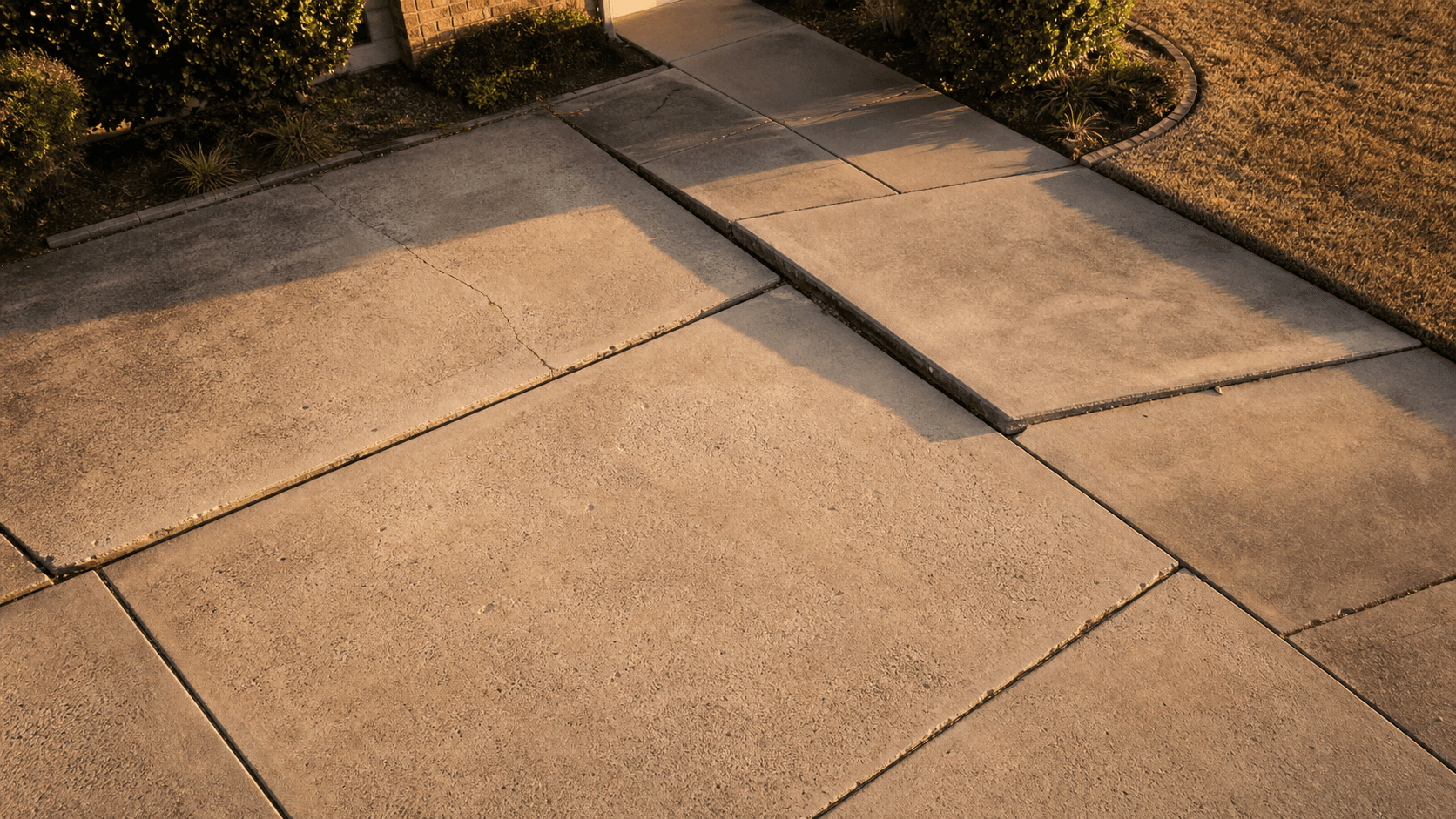
A driveway that drops an inch at the garage apron, a patio that pools water against the back door, a sidewalk panel that's caught the same toe twice this month — these are the calls that bring most homeowners to concrete leveling. The slab itself is usually fine. What's underneath it isn't. Before you start pricing tear-out and replacement, it's worth understanding the family of methods that lift settled concrete back to grade for a fraction of the cost.
Call us at +1 (682) 254-4938 to describe what you're seeing.
What concrete leveling is (and what it isn't)
Concrete leveling is the umbrella term for any process that returns a settled slab to its original grade without removing it. Three methods make up the vast majority of jobs: mudjacking, polyjacking, and — when neither of those is appropriate — full replacement. Each addresses the same underlying problem from a different angle.
Mudjacking, sometimes called slabjacking, pumps a slurry of cement, sand, and water under the slab through small ports drilled in the surface. The slurry fills the void created by soil settlement, displaces any standing water, and lifts the slab as pressure builds. It's the older method — homeowners have been running mudjacking trucks since the 1930s — and it's still the right call for thick, heavy, or older slabs that need substantial weight underneath them to stay level.
Polyjacking, also called foam injection or polylift, uses a two-part polyurethane foam pumped through smaller ports. The components mix in the injection gun, react inside the void, and expand to lift the slab with controlled force. Foam is far lighter than slurry, cures to structural strength within about 15 minutes, and works through smaller drill holes that are easier to patch.
What concrete leveling is not: it isn't a fix for a slab that's structurally compromised. If your concrete has heavy spider-web cracking, exposed and corroded rebar, or settlement greater than three inches, you're looking at replacement, not lifting. Leveling also doesn't address the root cause — the soil underneath that moved in the first place. In North Texas, that usually means clay soil expanding and contracting through wet-dry cycles. Lifting buys you years; soil management is how you keep them.
When concrete leveling is the right call
The clearest signal is a slab that has dropped without significant cracking. The concrete is doing its job; the dirt underneath stopped doing its. Specific scenarios where leveling beats replacement:
- Settled driveway apron — the section where the driveway meets the garage floor or the street curb is the first place a driveway tends to drop. Leveling brings it flush again, eliminates the bump that's catching your bumper, and avoids the cost of cutting out and re-pouring a driveway segment.
- Sunken garage floor near the door threshold — interior garage slabs settle most often along the front wall as the soil under that perimeter consolidates. Polyjacking lifts the slab without removing tools, cabinets, or the cars in many cases.
- Patio with water pooling against the house — a patio that has tilted toward the foundation rather than away from it is a drainage problem first and a concrete problem second. Leveling restores the slope and stops water from being directed at your slab edge or stem wall.
- Pool deck that's separating from the coping — pool decks settle outward from the pool shell as the surrounding fill consolidates over time. Foam injection lifts the deck back gently without disturbing the bond beam or pool tile.
- Sidewalk trip hazard — a one-inch lip between sidewalk panels is an ADA liability for commercial property and a homeowner concern for residential. Leveling removes the hazard in a single visit, no demolition required.
- Settled AC pad or shed slab — small flatwork pours often settle differently from the main slab they're poured beside. Leveling restores their relationship to the larger slab without disturbing the equipment sitting on top.
If your symptom is on this list, leveling is almost certainly worth pricing before you call anyone with a jackhammer.
What concrete leveling costs
Concrete leveling pricing is driven by four variables: square footage of the affected slab, how much lift it needs, soil and void conditions underneath, and access. Industry ranges across DFW for residential work:
- Mudjacking: typical projects run $400 to $2,500 depending on slab size and lift. A single sunken driveway apron might come in near the bottom of that range; a full driveway lift sits in the middle; a multi-section back patio plus walkway approaches the top.
- Polyjacking: typical residential projects run $600 to $3,000. Foam costs more per cubic foot than slurry, but the materials advantage shows up on jobs where weight is a concern (decks above grade, slabs adjacent to foundations) or where fast cure matters (driveways the homeowner needs to use the next morning).
- Full slab replacement, as a reference point: a tear-out and re-pour of a typical residential driveway runs several times what either leveling method costs, and that's before you account for landscaping and sprinkler-line damage during demolition.
We don't quote by phone. The reason is honest: until we walk the slab, probe the joint depths, and see how the lot drains, any number we throw out is a guess. The on-site assessment is free. The quote you get afterward is the quote.
How the work goes
A typical leveling job runs four to six hours from arrival to drive-on. The crew arrives with the injection rig, pulls a coil of supply line to the slab, and marks port locations based on the void map and the lift pattern needed. Ports are drilled through the slab — about an inch and a half across for mudjacking, smaller for polyjacking. The injection nozzle seats into each port, and the operator pumps in measured pulses while watching a level laser or string line for the slab's response.
For mudjacking, the slurry enters at relatively low pressure and the slab rises as the void fills. The rate is slow enough to control to a quarter inch. For polyjacking, the foam reaches structural strength within about 15 minutes of injection; full cure is overnight; you can drive on most residential pours within 24 hours depending on temperature. Cold weather extends cure times for both methods.
After the lift, ports are patched flush with mortar (mudjacking) or backer rod and concrete grout (polyjacking). The patch is visible up close on a fresh job and weathers to near-invisible within a few months. The crew runs a final level pass and walks the slab with you before leaving.
When concrete leveling is NOT the right answer
Some slabs aren't lifting candidates, and a contractor who tells you otherwise is selling, not assessing.
If your slab has settlement greater than about three inches — large enough that the slab itself has bent or cracked through under its own weight — you've moved past leveling and into replacement territory. Lifting a structurally compromised slab can break it further, and the rebar inside is often corroded by that point.
If the slab is part of a load-bearing foundation (the house slab itself, not a flatwork extension off it), that's foundation work, not slab leveling, and it requires structural pier installation rather than void filling.
If the soil underneath is saturated and unstable — for example, after a major plumbing leak that's washed out a section of subgrade — leveling without first addressing the soil will lift the slab today and watch it drop again in a season. The honest sequence in that case is: fix the leak, let the soil stabilize, then level.
Concrete leveling FAQ
How long does a concrete leveling job last? A correctly executed lift on stable subgrade typically holds for 8-10 years or more. The variable isn't the lift; it's whether the soil keeps moving underneath it.
Will leveling crack my slab? A controlled lift puts very little stress on the slab. If the slab is already cracked, leveling won't usually widen the cracks meaningfully — but it won't close them either. Crack repair is a separate visit.
Can I be home during the work? Yes. The crew works outside or in the garage; you don't need to leave.
How soon can I use the slab after? Polyjacking: 24 hours for vehicle traffic in most cases. Mudjacking: 24-48 hours, longer if it's cold.
Is leveling worth it on a slab I'm planning to replace eventually? If "eventually" is more than two years out, almost always yes. Leveling buys you the use of the slab in the meantime for a fraction of replacement cost.
Do you guarantee the lift? We warranty the work itself. We don't warranty the soil. If the subgrade moves again from a plumbing leak, drought cycle, or grading change, that's a separate conversation.