
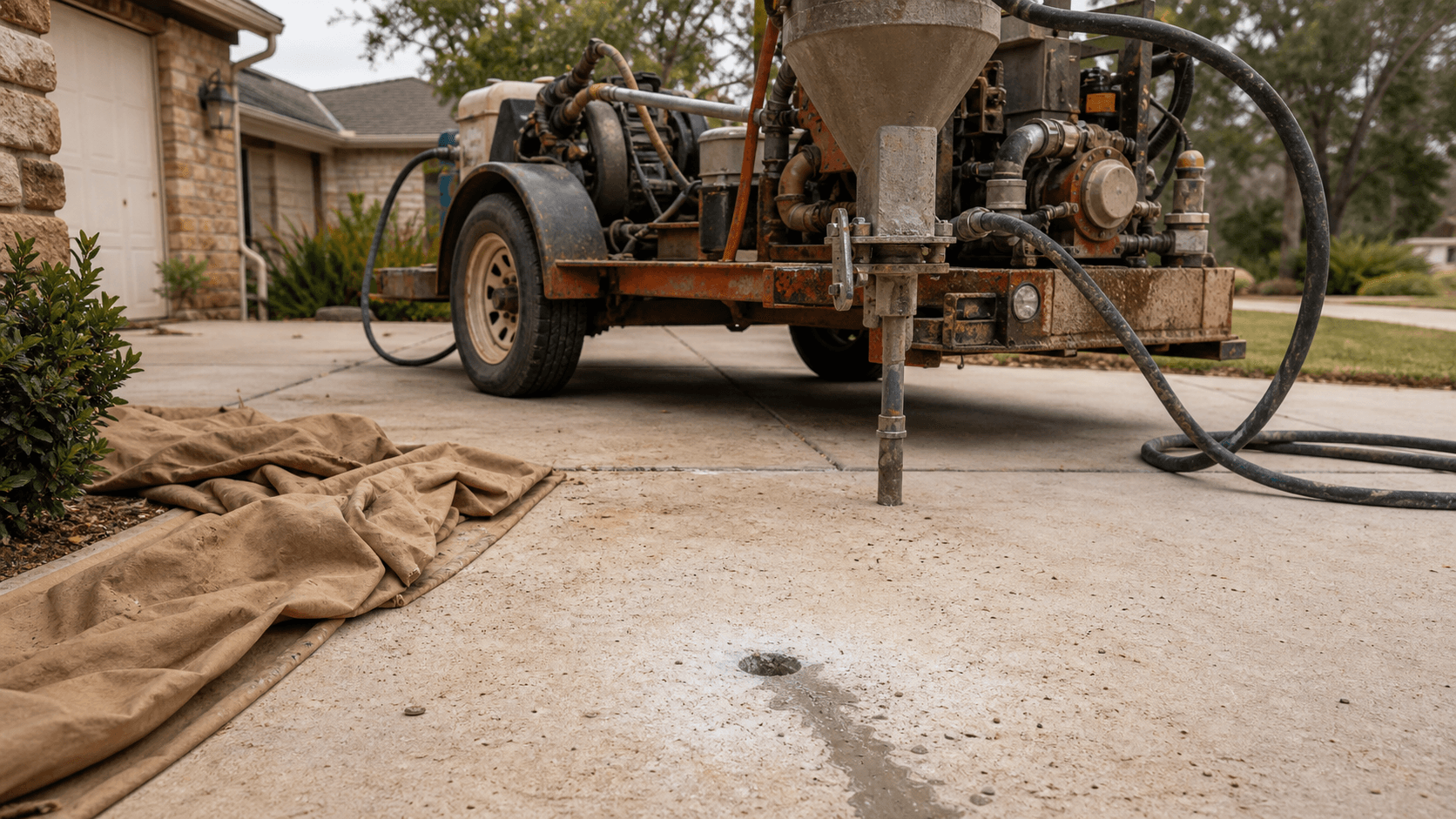
Mudjacking has been lifting settled concrete since the 1930s — long enough that "slabjacking" was the common name on highway-department invoices before most homeowners had ever heard of foam injection. The method is older, the equipment is louder, and the pump truck looks like something off a 1960s farm. None of which has stopped mudjacking from being the right call on a meaningful share of residential lifts in DFW, especially on the older, heavier slabs that this region poured through the 1970s and 1980s.
Call +1 (682) 254-4938 to describe your slab and find out if mudjacking is the right approach.
What mudjacking is (and what it isn't)
Mudjacking pumps a slurry of portland cement, sand, water, and sometimes a small percentage of fly ash or lime under a settled slab through ports drilled through the surface. The ports are typically about an inch and a half across — large enough to admit the slurry at a working flow rate. The slurry enters under low to moderate pressure, fills the void created by soil settlement, displaces any standing water, and lifts the slab as material accumulates underneath.
The "mud" in mudjacking is misleading. The mix isn't dirt; it's a controlled-strength cement slurry engineered to flow under pressure, set into a stable cured mass, and bear weight indefinitely once it hardens. After cure, the lifted slab is supported by what's effectively a cement-bound fill underneath it.
What mudjacking is not: it isn't a fix for structurally damaged concrete. If the slab itself is broken — heavy diagonal cracking, exposed corroded rebar, settlement past three inches with the slab visibly bent — mudjacking won't put it back together. It also isn't ideal for slabs immediately adjacent to foundations or above grade where added weight is a concern; that's where polyurethane foam earns its premium.
The honest positioning, as a 30-year veteran would put it: mudjacking is the right tool for thick slabs, heavily loaded slabs, slabs with substantial voids to fill, and homeowners for whom lower job cost matters more than getting back on the slab the same evening.
When mudjacking is the right call
The decision between mudjacking and polyjacking comes down to four factors: slab weight class, void volume, access, and timeline. Mudjacking wins in these scenarios:
- Older driveways poured before the 1990s — slabs from this era tend to be thicker than modern residential pours and benefit from the substantial weight-bearing fill that slurry provides underneath.
- Large flatwork sections with significant voids — when soil has pulled away from a slab over decades and left voids of multiple cubic feet to fill, slurry is the more economical material per unit volume.
- Garage slabs in detached garages and outbuildings — heavier point loads (vehicles, equipment) sit better on the broader bearing surface that a slurry fill creates.
- Public sidewalks and municipal flatwork — many city specifications still list cement-slurry slabjacking as the approved method for sidewalk-panel correction; it's the established practice with a long municipal track record.
- Patios and back walkways with unrestricted access — the truck and pump need a path to the slab; if your back patio is reachable through a side gate, mudjacking is straightforward.
- Budget-driven homeowners with a stable subgrade — when the soil isn't in active flux and the homeowner's priority is the lowest-cost route to a level slab, mudjacking is usually several hundred dollars cheaper than the polyurethane equivalent.
If your situation matches several of those, mudjacking is worth pricing before you commit to foam.
What mudjacking costs
Industry-typical residential mudjacking projects in DFW run $400 to $2,500 depending on the four cost drivers below.
- Square footage of slab being lifted — a single sunken driveway apron might come in near $400 to $700; a full one-car driveway lift sits in the $1,000 to $1,800 range; multi-section back patio plus walkway can approach $2,500.
- Lift height required — the higher the lift, the more slurry, the longer the job. A quarter-inch correction is fast; a two-inch correction takes meaningful pump time.
- Void volume underneath — a small void fills quickly; a large void from years of soil pull-away takes much more material to bring the slab to grade.
- Access to the slab — driveways and front sidewalks are easy. A back patio reachable only by carrying line through a narrow side gate adds labor time. Slabs with overhead obstructions or no truck-line route are sometimes mudjacked with portable pumps at higher cost.
We don't quote mudjacking by phone. The number you'd get without an on-site walk would be a guess, and we don't run the business that way. The site assessment is free; the quote afterward is the quote.
How mudjacking works (process)
A mudjacking crew typically arrives with a pump truck or trailer-mounted rig, a mixer, and the supply hose. Setup runs 30 to 45 minutes. The lead operator marks port locations across the slab — generally on a grid spacing of two to three feet for a uniform lift, denser where lift is needed most.
Ports are drilled through the slab to the void underneath. The injection nozzle seats into the first port, the pump engages, and slurry begins flowing under pressure. The operator watches the slab for response — a level laser or string line is the typical reference — and shifts to the next port as the lift becomes uniform across the slab. A controlled lift can be metered to roughly a quarter inch per pass, which is fine enough to bring most residential slabs to grade without overshoot.
After the lift, ports are patched flush with a cement mortar that color-matches reasonably well to most residential concrete. The patch is visible up close on a fresh job and weathers to near-invisible within a few months as the slab takes on the same surface dust and traffic patterns as the rest.
Cure is the slowest part. Slurry needs time to set to working strength before the slab is fully loaded. Foot traffic is typically fine within hours; vehicles need 24 to 48 hours; cold temperatures extend that window. Plan accordingly if the slab in question is a daily-use driveway.
When mudjacking is NOT the right answer
Mudjacking has clear limits, and a contractor who pushes it past them isn't doing you a favor.
If your slab is structurally compromised — extensive cracking, rebar exposure, settlement greater than about three inches, or a slab that has bent under its own weight — mudjacking won't restore it. Replacement is the honest answer.
If the slab is poured directly against your home's foundation and is settling toward the house, the added weight of slurry fill underneath can in some cases compound the soil-loading problem. Foam injection is usually the safer choice in tight foundation-adjacent geometry.
If the lift needs to happen and the slab needs to be back in service within a few hours, mudjacking is the wrong method. Slurry cure times can't be rushed. Polyjacking exists in part because that scenario was common enough to drive an industry shift.
And if access to the slab is genuinely impossible for a pump truck or trailer rig — no path for the line, overhead obstructions, no setup space within reasonable hose reach — the cost equation tilts toward foam, which can run from a smaller portable rig.
Mudjacking FAQ
How is mudjacking different from polyjacking? Mudjacking uses a cement slurry; polyjacking uses two-part polyurethane foam. Slurry is heavier, cheaper per cubic foot, and longer-curing. Foam is lighter, faster-curing, and more expensive per job. Both lift slabs to grade — the choice is about slab weight class, access, and timeline, not which is "better."
How long does a mudjacking lift hold? A correctly executed lift on stable subgrade typically holds 8-10 years or more. The lift itself is durable; the variable is whether the soil underneath continues to move.
Can mudjacking damage my slab? A controlled lift puts very little stress on the slab. The risk is overshoot — too much pressure or too much material at one port — and that's an experience problem, not a method problem.
How big are the holes you drill? Typically about an inch and a half across. Each is patched flush with cement mortar after the lift.
How soon can I use the driveway after? Foot traffic is usually fine within hours. Vehicles wait 24 to 48 hours, longer in cold weather.
Is mudjacking outdated? It's older, not outdated. Mudjacking is still the right call on a meaningful share of residential and municipal lifts; foam injection didn't replace it, it added a complementary option.
Do you guarantee the work? We warranty the lift itself. We don't warranty the soil — if a plumbing leak or drought-cycle movement disturbs the subgrade later, that's a separate conversation.