
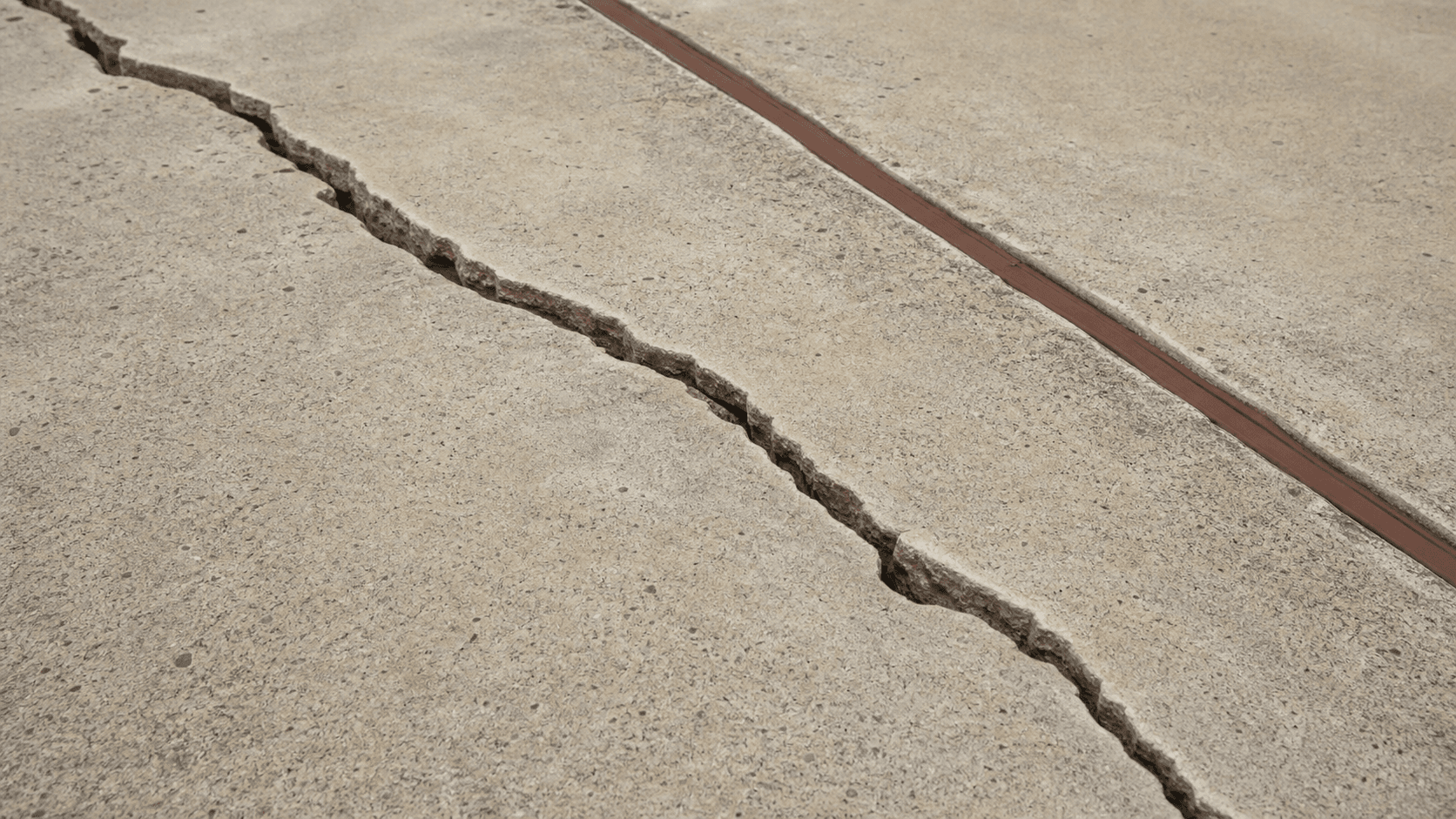
A slab can fail two ways at once. It can drop — the soil moves, the concrete settles — and that's a job for leveling. Or it can stay at grade and crack, spall, or open at the joints — and that's a job for slab repair. The two often happen together on older DFW concrete, but they're separate problems with separate solutions, and a contractor who treats every cracked slab as a leveling job (or every settled slab as a crack-repair job) is missing half the picture.
Call +1 (682) 254-4938 to describe what your slab is doing and we'll tell you which conversation we're having.
What slab repair is (and what it isn't)
Slab repair is the family of techniques that address damage to concrete that hasn't dropped — or that needs cosmetic and structural restoration after a lift. The four main scopes:
- Crack injection — filling cracks with a polyurethane or epoxy resin that bonds the two faces back together. Polyurethane stays flexible and is the typical choice for cracks that are still moving with seasonal soil cycles. Epoxy is rigid, stronger in tension, and used where the crack is dormant and structural reconnection is the goal.
- Joint resealing — replacing the failed sealant in expansion joints and control joints. The original joint sealant on a 1980s residential slab has almost certainly weathered out by now. Open joints let water through to the subgrade, accelerate edge spalling, and start the void-formation cycle that leads to settlement later.
- Surface restoration — patching spalled areas, resurfacing flaked concrete, color-matching repairs to existing slab. This is the cosmetic end of the work and the visible end for homeowners.
- Full-depth panel repair — when a section of slab has cracked clean through and the two halves no longer move together, the panel may need to be cut out, formed, and re-poured. This is repair, not replacement, when the rest of the slab is sound.
What slab repair is not: it isn't a lift. If your slab has dropped — visibly settled below its neighbors, no longer at grade with the garage floor or the house — repair won't bring it back up. That's leveling, and the two visits are sometimes scheduled together.
It also isn't a fix for a slab that's structurally finished. If the cracking is so extensive that the slab no longer functions as a single piece — heavy spider-web fracturing, exposed corroded rebar across multiple sections, settlement past three inches — replacement is the honest answer.
When slab repair is the right call
Specific scenarios where repair beats both leveling and replacement:
- Hairline cracks that are widening seasonally — a crack that's a thirty-second of an inch in spring and an eighth in late summer is moving with the clay underneath. Polyurethane crack injection bonds it flexibly and reduces water intrusion through the crack to the subgrade.
- Expansion joints that have lost their sealant — walk a 1990s patio in DFW and the joints will almost universally be empty or filled with weathered debris. Resealing buys years of slab life by keeping water from cycling through to the dirt below.
- Spalled or flaked surface from a freeze-thaw event — the rare hard freeze in this region pulls surface moisture into the top layer of concrete, freezes it, and pops the surface paste loose. Resurfacing restores the wear face without touching the structural slab below.
- Edge damage at driveway aprons and curb ramps — concrete edges chip and break under wheel loads over time. Edge repair patches the loss back to a flush profile without recutting the panel.
- A slab that's about to be lifted — when leveling is scheduled, cracks and joints are repaired either just before or just after the lift. Doing both in a coordinated visit is more efficient than two separate calls.
- Cosmetic restoration before sale — a homeowner preparing to list a property often wants the visible damage addressed without the cost or disruption of replacement. Surface restoration handles that scope cleanly.
If your slab is at grade but visibly damaged, repair is almost always the right starting point.
What slab repair costs
Slab repair pricing varies more by scope than by square footage because the work is selective rather than uniform.
- Crack injection: typical residential pricing falls in the range of $15 to $30 per linear foot of crack treated, with minimums applied for small jobs.
- Joint resealing: a typical patio or driveway joint reseal runs $300 to $1,000 depending on linear footage and the existing joint condition.
- Spall and surface patching: per-area pricing — small patches start under $200, larger resurfacing jobs scale into the $800 to $2,500 range.
- Full-depth panel cut-and-pour: when a section needs to come out and back, pricing is comparable to a small new pour — typically several times the cost of repair on the same area.
We don't quote slab repair by phone. The number depends on which cracks, which joints, and what condition we find when we walk the slab. The site visit is free.
How slab repair works (process)
A repair visit typically runs two to four hours depending on scope. The crew arrives, walks the slab with the homeowner, marks every crack and joint to be addressed, and sequences the work.
For crack injection, the crack is first cleaned out — debris, dirt, and old sealant removed. A backer rod is set if the crack is wide enough to warrant one. Polyurethane or epoxy is then injected with a manual cartridge gun or a pumped system, working from one end of the crack to the other, watching the resin fill and rise. The injected material is tooled flush to the surface before it sets.
For joint resealing, the existing sealant is cut out with a router or chisel, the joint is cleaned and dried, and a fresh sealant — typically a polyurethane joint sealant rated for traffic exposure — is applied with a follower rod underneath to control depth.
Surface patches are mixed on-site with a polymer-modified concrete patch product, applied to the prepared area, screeded flush, and tooled to match the existing surface texture. Color-matching to a 30-year-old slab is approximate; the patch will weather to a closer match over months.
Cure times vary by product. Most polyurethane sealants and patch products are walkable within hours and traffic-ready within 24 hours; epoxy crack-injection cures harder and longer than polyurethane.
When slab repair is NOT the right answer
Not every cracked slab is a repair candidate.
If the cracking is so extensive that the slab no longer holds together as a structural piece — multiple major cracks intersecting, sections that move independently of each other, exposed and corroded rebar — repair is throwing money at a slab that needs to be replaced.
If the cracks are the symptom of an active subgrade failure — soil washing out from a plumbing leak or major drainage issue — repairing the cracks without fixing the cause means the cracks will reopen. The honest sequence is: address the water source, allow the subgrade to stabilize, then repair.
If the slab has settled meaningfully, repairing the cracks before lifting is wasted work — the lift will reopen them. Sequence the leveling first, then the repair.
And if the homeowner's goal is a finished surface for high-resale appeal, large-area surface restoration sometimes costs enough that a partial replacement starts to make economic sense. We'll be honest about that math during the assessment.
Slab repair FAQ
Can you repair a cracked slab without lifting it? Yes — if the slab is at grade. Repair addresses cracks, joints, and surface damage on a slab that hasn't settled. If it has settled, leveling comes first.
What's the difference between repair and replacement? Repair keeps the existing slab and addresses specific damage. Replacement removes the slab and pours a new one. Repair is faster, less expensive, and less disruptive when the slab is sound.
Will the crack come back after injection? A polyurethane injection on a moving crack flexes with the slab and typically holds for years. An epoxy injection on a dormant crack is structural and effectively permanent. Cracks come back when the underlying soil movement returns; the repair didn't fail, the conditions changed.
How long does joint sealant last? Quality polyurethane joint sealant in residential exposure typically lasts 5-10 years before it needs refreshing. Cheaper sealants fail faster.
Can I do crack injection myself with hardware-store products? You can buy injection kits, and they work on small dormant cracks. Active cracks moving with seasonal soil cycles need a flexible polyurethane that DIY products often don't match.
Should I repair before selling? Visible cracks and failed joints affect curb appeal and inspection reports. Whether the cost is worth it depends on the price point of the home. We'll give you the honest answer during the assessment.