
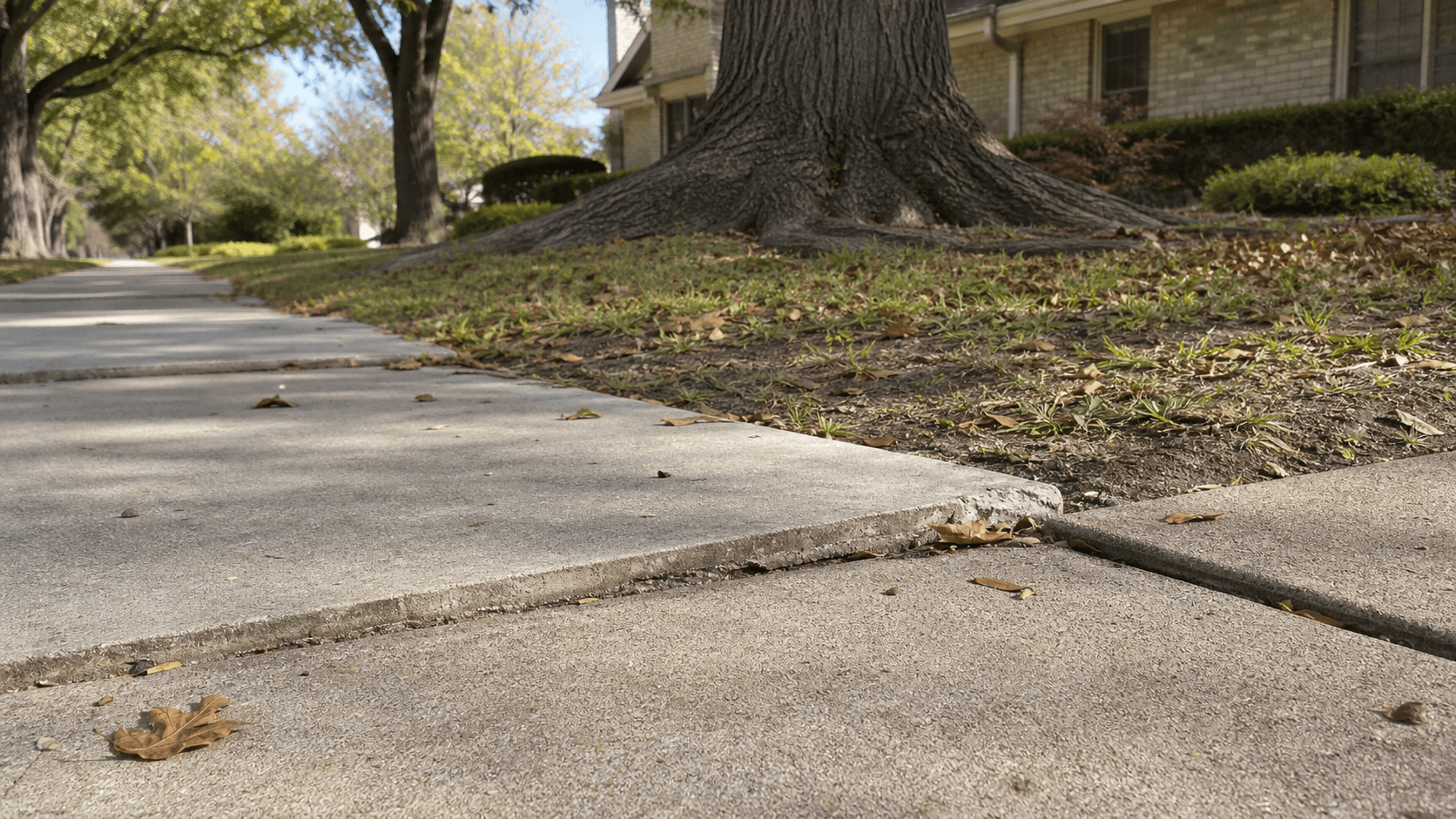
The driveway is the most visible piece of concrete on most properties, and the sidewalk is the one that creates legal exposure when it fails. Together they represent the bulk of homeowner concrete repair calls — settled aprons, cracked panels, trip hazards between sidewalk sections, edge spalling along the curb. Most of this work doesn't require demolition. A meaningful share of it can be lifted in a single visit. The cases that genuinely need replacement are usually obvious, and the honest assessment will tell you which category your slab falls into.
Call +1 (682) 254-4938 to describe what you're seeing.
What driveway and sidewalk repair is (and what it isn't)
Driveway and sidewalk repair covers four main scopes, each addressing a different failure mode:
- Concrete leveling — lifting settled sections back to grade with mudjacking or polyjacking. The most common scope; addresses the dropped apron at the garage, the sunken panel at the street, the sidewalk section that has tilted away from its neighbor.
- Trip-hazard correction — specifically targeting the lip created where one sidewalk panel has settled below the next. Sometimes done by lifting the dropped panel; sometimes by grinding the higher edge down to a flush profile.
- Crack and joint repair — addressing visible damage on slabs that haven't settled. Polyurethane crack injection, joint resealing, edge patching.
- Panel replacement — cutting out and re-pouring individual sections of driveway or sidewalk that are too damaged to repair. Usually limited to one or two panels rather than the entire run.
What this work is not: it isn't a fix for an entire driveway that has structurally failed across multiple panels. If most of the slabs are spider-web cracked, settled past three inches, or showing exposed corroded rebar, full replacement is the honest answer. It's also not foundation work — these slabs are flatwork, separate from the home's structural foundation.
When driveway and sidewalk repair is the right call
Specific scenarios where targeted repair beats full replacement:
- Settled driveway apron at the garage — the section where the driveway meets the garage floor is the most common settlement point. Lifting brings it flush again and stops the bumper-scrape that's been catching the front of the car.
- Dropped panel at the street curb — driveways often settle at the curb cut because that's where the original construction disturbed the most soil and the wheel loads concentrate. Lifting beats cutting out the panel and re-pouring.
- Sidewalk trip hazard between panels — a one-inch lip between adjacent sidewalk panels is an ADA liability for commercial property and a homeowner concern for residential. Lifting the dropped panel restores the flush profile.
- Cracked driveway with the slab still at grade — if the slab hasn't dropped but has cracked from soil cycling, polyurethane crack injection and joint resealing buys years of additional service life without replacement.
- Spalled or flaked surface from a freeze-thaw event — surface restoration patches the wear face without touching the structural slab below.
- Public sidewalk along a property frontage — many municipalities hold the adjacent property owner responsible for sidewalk condition. Lifting and crack repair addresses the liability without the cost or permitting of replacement.
If your situation is on this list, repair is almost certainly worth pricing before you commit to a tear-out.
What driveway and sidewalk repair costs
Pricing varies widely by scope because the work ranges from a single trip-hazard correction to a multi-panel lift.
- Single-section driveway lift (one apron or one panel): typical range $400 to $1,200.
- Full driveway lift (multiple sections, full apron, curb cut): typical range $1,200 to $3,000 depending on size and lift height.
- Sidewalk trip-hazard correction (single lip): typical range $200 to $600, sometimes lower for grinding-only fixes.
- Crack injection on a driveway: typical range $15 to $30 per linear foot of crack treated, with minimums applied.
- Joint resealing for a residential driveway: typical range $400 to $1,000 depending on linear footage.
- Single-panel cut-and-pour replacement: typical range $800 to $2,500 depending on panel size and access; the high end on a thicker driveway panel with limited access.
We don't quote driveway or sidewalk repair by phone. Until we walk the slab, see how the panels sit relative to each other, and look at the joint and crack conditions, the number is a guess. Site visit is free.
How driveway and sidewalk repair works (process)
Most driveway and sidewalk lifts run two to five hours depending on scope.
For a leveling job, the crew arrives with the appropriate rig — pump truck for mudjacking, portable rig for polyjacking — and walks the slab with the homeowner to confirm the lift plan. Ports are drilled, material is injected in controlled pulses, and the slab rises toward grade as the void underneath fills. The operator works to a level reference (laser or string line) and patches the ports flush after the lift.
For a trip-hazard correction, the choice between lifting and grinding depends on how much height differential is present and what's under the panels. A small lip on otherwise sound panels is sometimes ground down to a flush profile in 30 minutes. A larger differential, or a panel that has dropped because of subgrade loss, is lifted back into position.
For crack injection and joint resealing, the work is selective rather than uniform — the crew marks every crack and joint to be addressed, sequences the work, and runs through cleaning, prep, injection, and tooling on each one in turn.
For a panel replacement, the bad section is sawcut out, the subgrade is prepared, forms are set, and the new pour is placed and finished. Cure time before vehicle traffic on a fresh concrete pour runs days, not hours — typically the pour is set up so the homeowner can park around the section while it cures.
When driveway and sidewalk repair is NOT the right answer
Some cases are genuinely past repair.
If multiple panels have settled significantly and are also cracked through, the honest answer is replacement. Lifting some panels while leaving others to fail in the next year is patchwork that won't end well.
If the driveway has heavy spider-web cracking across most of its surface, exposed and corroded rebar, or settlement past three inches with the slabs visibly bent, replacement is the honest call. Lifting a structurally finished driveway can break it further.
If the sidewalk failure is part of broader ADA-compliance work for a commercial property, the scope sometimes expands beyond a single-panel correction. A targeted lift might solve one trip hazard while leaving compliance issues elsewhere on the run.
And if the driveway is up for a major design change — widening, repouring at a different elevation, replacing decorative finish — repair on the existing slab is throwing money at concrete that's coming out anyway.
Driveway and sidewalk repair FAQ
Can a sidewalk trip hazard really be fixed without replacing the panel? Yes, in most cases. Lifting the dropped panel back to flush, or grinding the high edge down, both work depending on the situation. Replacement is rarely needed for a single trip hazard.
Who's responsible for sidewalk repairs — the city or me? This varies by municipality. In most DFW cities, the adjacent property owner is responsible for maintaining the sidewalk along their frontage. We can work either side of that question; the city office has the definitive answer for your address.
Can mudjacking damage my driveway? A controlled lift puts very little stress on the slab. The risk is uncontrolled injection or overshoot, which is an experience problem, not a method problem.
Will the patches show on my driveway? The drill ports are patched flush with mortar (mudjacking) or grout (polyjacking). Patches are visible up close on a fresh job and weather to near-invisible within months.
How soon can I park on the driveway after a lift? Polyjacking: 24 hours typically. Mudjacking: 24-48 hours, longer in cold weather.
Should I just replace the whole driveway? If it's structurally finished, yes. If most of the panels are sound and only specific sections have failed, lifting and repair is several times less expensive and gets the same functional result.
Is leveling worth it if I'm planning to sell? Visible settlement and cracks affect curb appeal and inspection reports. Whether the cost is worth it depends on the price point of the home, but a smooth, level driveway is one of the higher-ROI cosmetic moves before listing.
How long does a driveway lift hold? A correctly executed lift on stable subgrade typically holds 8-10 years or more. The variable is whether the soil underneath continues to move with seasonal cycles.