
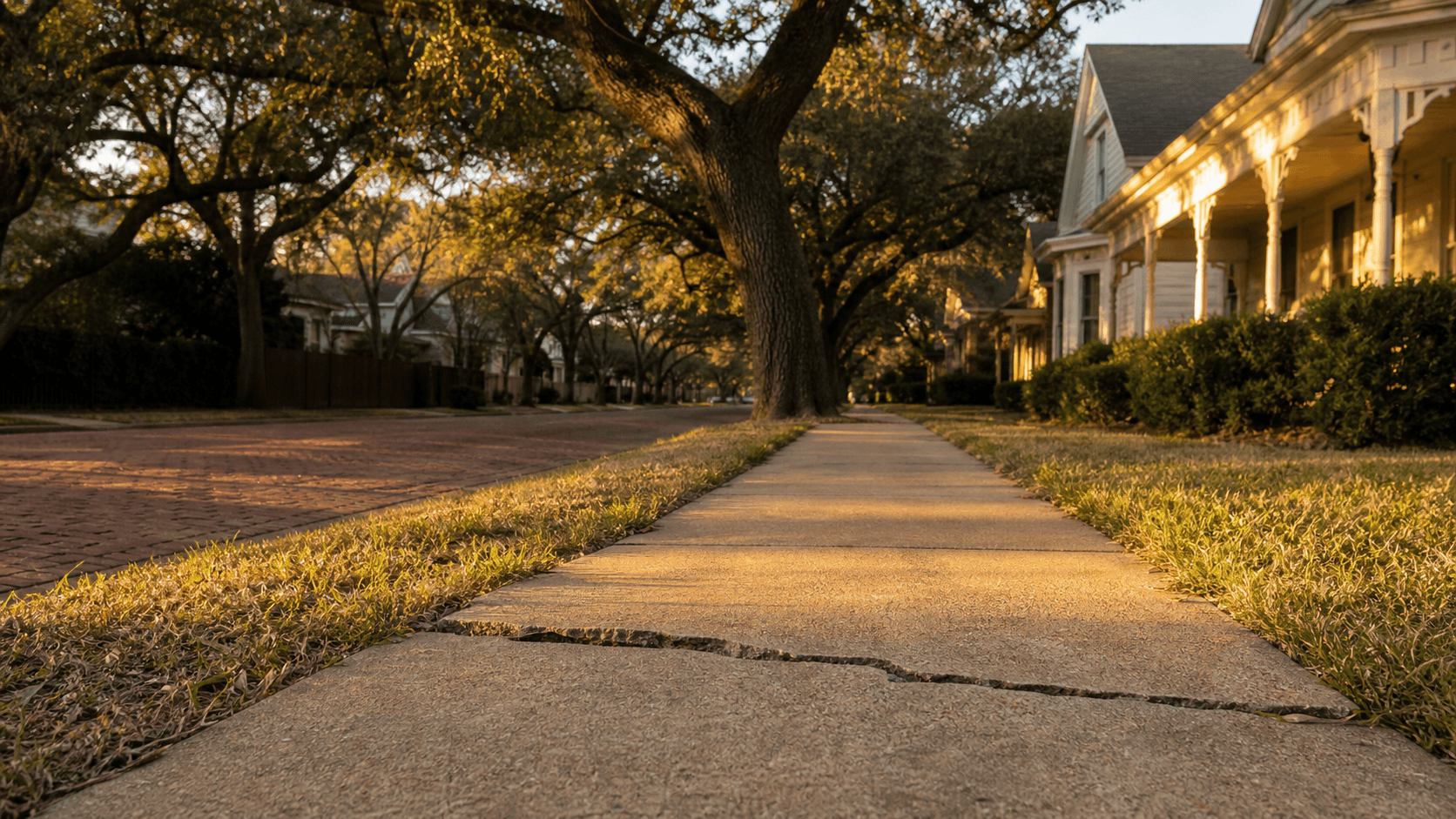
If you're seeing a settled walkway, a sunken section of patio, or a driveway that's cracked along an expansion joint, call us to walk the property and tell you what it is.
Why McKinney Homes Need Concrete Leveling
The dominant soil series at McKinney's seed location is Houston Black, and it makes up 80% of the mapped unit there — a remarkably homogeneous footprint compared to most cities, where the dominant component might run 50–60% with the rest split among related series. That homogeneity matters: it means almost every property in this ZIP is sitting on the same kind of reactive clay, regardless of which subdivision you're in.
The linear extensibility on that clay is 12% — the percentage of volume change between fully wet and fully dry states. That's lower than Richardson's 17% but still well inside the USDA's "very high" shrink-swell bucket. The practical translation is the same: ground that moves with moisture, and a slab that moves with the ground.
Drought is the second half of the story. Over the last 53 recorded weeks, at least a quarter of Collin County sat at D1 (moderate drought) or worse for 14 of those weeks — about a quarter of the year. There hasn't been a headline D2 event in this window; the issue is the slow, persistent pull of moisture out of the top soil layers, then a rebound when May rain comes. Annual precipitation here is 36.1 inches, with May the wettest month and August the driest. That swing — heavy spring rain into bone-dry late summer, with July averaging 95.6°F highs — is exactly the cycle that opens hairline cracks and works gaps under concrete.
The third variable is the housing stock. McKinney's 75070 ZIP has a median year built of 2010, putting it in the "modern" bucket alongside Frisco. Slabs of this era are typically post-tension and were poured to current residential standards — but "current standards" don't make a slab immune to expansive clay. They mean the slab is more likely to move as a unit instead of cracking apart, which shifts the failure mode from interior slab cracks to settled flatwork outside the foundation: driveways, garage approaches, sidewalks, pool decks, A/C pads. That's most of what we lift in this city.
Common Scenarios on McKinney Slabs
The calls we field in McKinney tend to cluster around a handful of recurring scenarios, and the homeowner is almost always surprised that a 12- or 15-year-old property is already showing them.
Settled driveway aprons. The transition between the garage slab (which sits on the foundation) and the driveway (which sits on grade) is the single most common failure point in modern McKinney builds. The garage doesn't move much; the driveway does. Over a decade of clay cycling, the driveway side drops a half-inch to two inches at the apron, and you start scraping the bottom of the bumper every time you pull in.
Pool deck settling. Stonebridge Ranch and the master-planned communities along Hardin Boulevard built a lot of pools in the 2005–2015 window. The pool itself is engineered to a different standard than the deck around it, so what we typically see is the deck dropping away from the coping while the pool stays where it is. Lifting the deck back to grade is almost always cheaper and faster than tearing it out.
Sidewalk and walkway lifts. Front walks, side gates, and the path from the back patio to the pool gate are usually poured as a single ribbon that crosses several different fill conditions. One end settles, the other doesn't, and you're left with a trip hazard at a control joint. These are quick polyurethane lifts in most cases.
A/C pad and generator pad drops. The smaller flatwork around mechanical equipment doesn't carry much load, so it's the first to drop when the clay underneath shrinks. We see this constantly on McKinney builds — units pulling away from the conduit, line sets stressed, condensate lines tilted the wrong way.
Garage floor settling near the overhead door. Less common, but it happens — usually on lots where the garage was poured on a deeper fill section. The slab itself is fine; the subgrade dropped. Polyjacking can lift it back without removing what's stored on it.
Patio sections separating from the house. A back patio poured cold-jointed against the foundation will eventually drift if it's settling. We see hairline gaps grow into half-inch separations over a few wet-dry cycles.
The diagnostic step is always the same: identify whether the slab itself is cracked or just resting on settled subgrade. If the slab is sound, lifting is the right call. If it's structurally compromised, we tell you that too.
What Concrete Leveling Costs in McKinney
For most McKinney calls, mudjacking quotes run roughly $400 to $2,500 depending on the area being lifted and the access conditions, and polyurethane (polyjacking) runs roughly $600 to $3,000 for the same scope. Full slab tear-out and replacement starts around $4,000 for a small section and runs well past $15,000 for a full driveway. Those are regional ballpark ranges — your actual quote depends on how many lift points are needed, how much material goes underneath, and whether there's any concrete repair stitched into the same visit.
The cost-to-protect math in McKinney usually favors lifting. With median home values in 75070 at $429,300 and most of the housing stock under 20 years old, the slab itself is typically still in good condition — it's just sitting on subgrade that has dropped. Replacing perfectly good concrete because the dirt under it moved is rarely the right answer when polyurethane can re-support it for a fraction of the cost and let you walk on it the same day.
The owner-occupancy rate in this ZIP is 52.4%, which means roughly half the units are tenant-occupied. Landlords and property managers face the same Houston Black clay as everyone else, and the same ROI calculation: a $1,500 lift now beats a $9,000 driveway replacement two years from now after the cracks propagate.
How Our McKinney Partners Work
The process is straightforward and we don't oversell it.
On-site assessment. We come out, walk the property, measure the drop with a level or laser, and tell you whether the slab is a candidate for lifting or whether it needs to come out. No phone-quote guessing.
Method selection. Mudjacking — pumping a cement-and-soil slurry under the slab — is the older method and still right for some jobs, especially larger slabs where the volume of fill needed makes polyurethane uneconomical. Polyjacking — injecting expanding polyurethane foam through small ports — is the right call for most smaller slabs because it cures faster, weighs less, and doesn't add hydrostatic load on the subgrade.
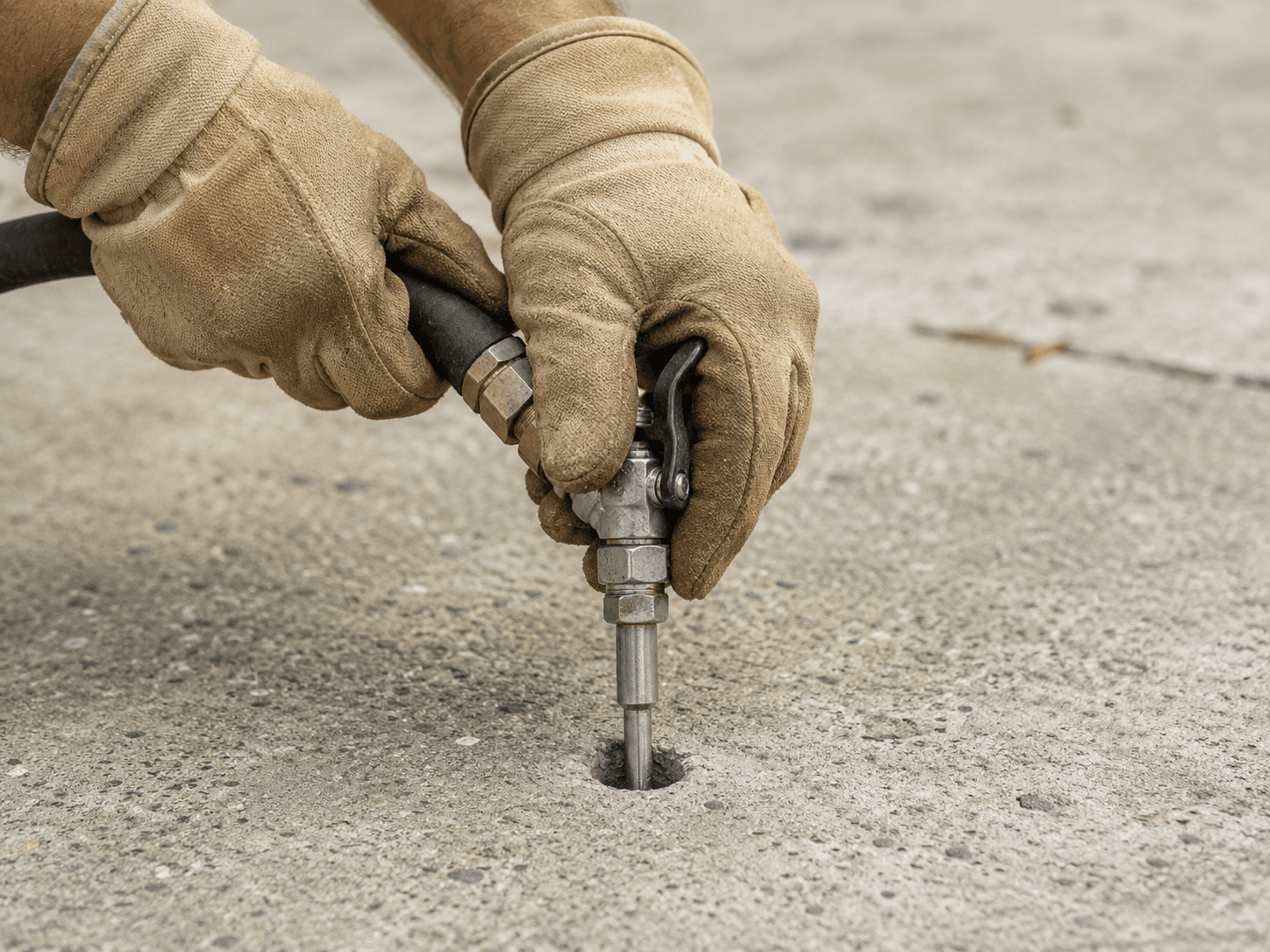
Drilling and injection. We mark a port pattern, drill clean holes, and inject in stages while watching the slab rise to the target elevation. Most jobs take a few hours.
Cure and finish. The ports are patched. With polyurethane, the slab is structurally loaded within minutes; you can drive on it the same day in most cases. With cementitious slurry, it's a longer wait but still measured in hours, not days.
We don't quote slab thickness or rebar specs we can't see. If you want a structural opinion on a slab we haven't lifted, we'll tell you to bring in a structural engineer — that's a different scope.
McKinney Neighborhoods We Serve
We work the entire McKinney footprint, north of Sam Rayburn Tollway and east and west of US 75. The largest single area we get calls from is Stonebridge Ranch — the master-planned community west of US 75 that covers more than 5,000 acres and contains roughly 70 villages, with build dates spanning the late 1980s through the 2010s. Within Stonebridge Ranch, Adriatica Village — the 45-acre Croatian-style enclave with its lake and bell tower — has its own characteristic mix of condo and single-family flatwork.
A point worth flagging on Stonebridge Ranch specifically: the first five villages were platted and built in 1988, and development continued in waves through the 2010s. That means villages built in the late 1980s have had roughly 37 years of Houston Black underneath them while the newest sections have had under a decade — the same master-planned community can produce two very different concrete-repair conversations depending on which village your address is in. We try to ask which village before we drive out, because the typical drop pattern at year 35 is not the typical drop pattern at year 8.
Beyond Stonebridge Ranch, we cover the corridor along Hardin Boulevard, the older sections around the historic downtown McKinney square — the original Old Town platted in 1849 around the courthouse, listed as a National Historic Landmark district since 1978 — and the newer subdivisions east of US 75 and along the SH 121 / Sam Rayburn Tollway frontage. The slabs in and around the downtown square are a different generation of concrete than what you'll find in any master-planned subdivision: smaller pours, mixed-era patches, and decades of repeated re-work as the buildings around them changed hands. Lifting in that footprint is more diagnostic than mechanical — figuring out which historical pour you're actually working with is half the job.
The OSM open geographic record returns zero tagged neighborhoods inside McKinney's city boundary — coverage of suburban DFW subdivision polygons is genuinely thin in the open dataset — so the practical reference points for most homeowners are the master-planned community names, the major arterials, and the school attendance zones.
If your address doesn't fall in any specific named subdivision, that doesn't change anything for us. The clay underneath doesn't care about subdivision boundaries.
McKinney Concrete Leveling FAQ
How much does concrete leveling cost in McKinney? Most jobs fall in the $400 to $3,000 range depending on method, area, and access. Polyjacking tends to run higher per square foot than mudjacking but lower in total because less material is needed. We give a firm quote on-site after we've seen the slab — phone quotes are guesses.
Mudjacking or polyjacking on Houston Black clay? Both work. Polyurethane is lighter, cures faster, and doesn't add weight to the subgrade — that matters on swelling clay because heavier fill can compound the problem when the soil swells back. Mudjacking is still appropriate for very large slabs where the foam volume would be uneconomical, and for some agricultural or commercial scopes. For most residential McKinney work, polyurethane is the default.
How long does the lift hold on shrink-swell soils? A properly executed polyurethane lift on a sound slab typically holds for many years. The clay will keep cycling, but the foam doesn't absorb water and doesn't compress under normal residential loads, so the slab stays where you put it. The lift can fail early if the underlying issue isn't subgrade settlement at all but a structural slab crack — that's why the on-site assessment matters.
Will my driveway need to be replaced eventually? Maybe, but probably not because of the lift. Concrete has a finite service life on Houston Black regardless of what you do. A 12-year-old driveway that's lifted now will still be a 25-year-old driveway in 13 years and may need replacement at some point. But you've bought 10+ more years of useful life for a fraction of replacement cost.
Can you fix a settled garage floor without removing what's on it? Often yes. Polyjacking only requires small drill-port access, and the foam works underneath the slab — we don't need clearance above it the way mudjacking sometimes does. We've lifted garage floors with cars, shelving, and full storage in place.
What's a typical visible warning sign on McKinney slabs? The earliest reliable sign on most properties here is a gap opening at a control joint where the driveway meets the garage apron, or a hairline crack running diagonally from a corner of the patio. By the time you can fit a quarter under a slab edge, you're well into the actionable range — that's the call to make.
Does drought make this worse? Yes. The 14 weeks of D1 conditions in the last year have been quietly working against the clay's water content all summer, and a wet spring rebounds it. That cycle is what we're really fighting. There's no way to stop the soil from doing what it does — the answer is to design (or repair) the concrete so the lift can be re-set when it does.
Do you work in older parts of McKinney too? Yes. The historic downtown square and the older streets immediately around it have a meaningful share of mid-century housing on the same clay. Older slabs have different failure patterns than the 2010-era stock — more crack-driven, less settlement-driven — but they're still candidates for lifting where the slab is otherwise sound.
Talk it through with someone who works McKinney.
Describe what you're seeing — a crack, a sunken slab, a foundation question, a new pour. We'll tell you what it likely is and what it costs to fix.
Call (682) 254-4938