
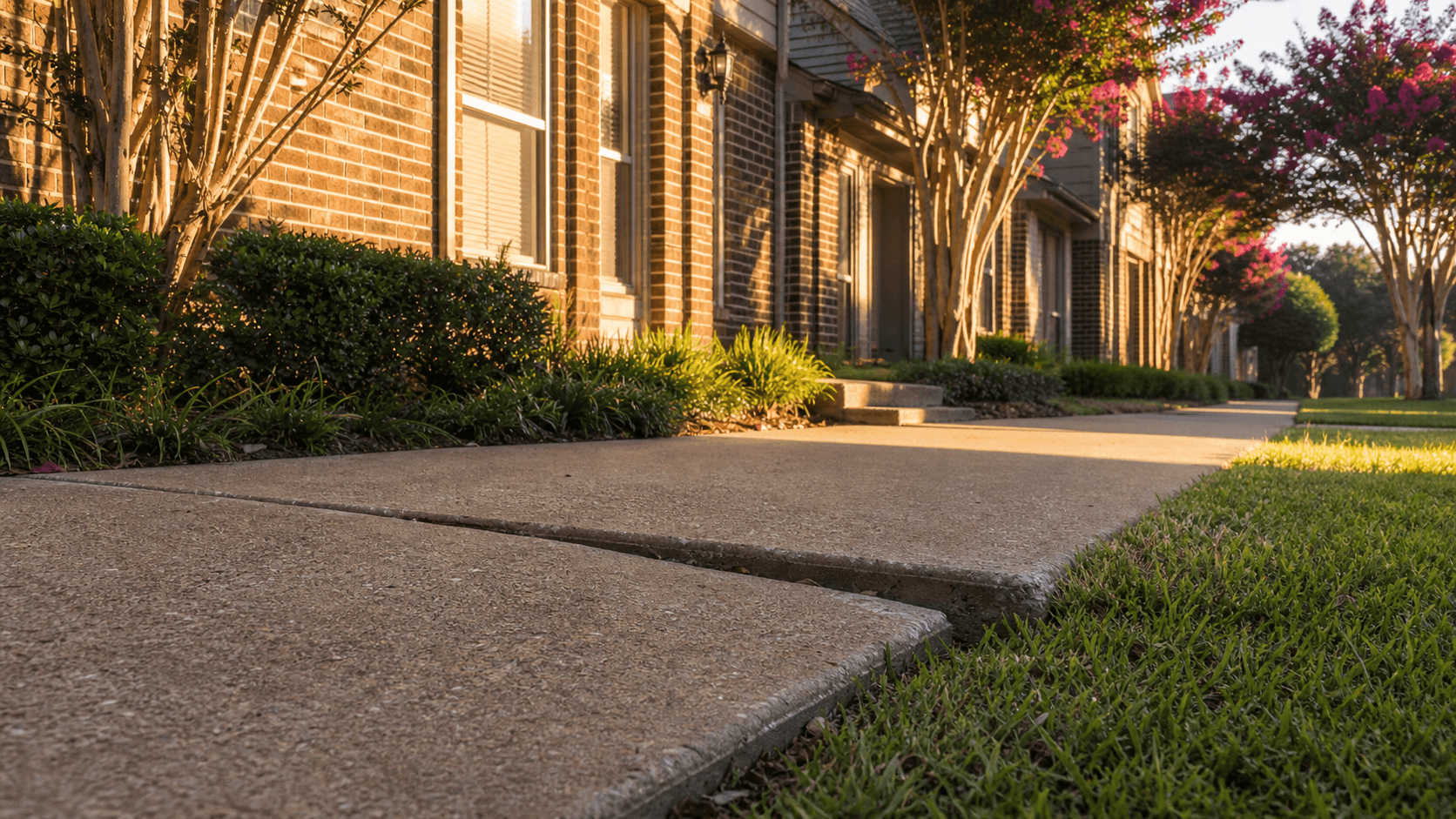
If you're seeing flatwork that has settled, cracked, or pulled away from the house, call us to walk the property and tell you what's happening underneath.
Why Plano Homes Need Concrete Leveling
The dominant soil series at Plano's seed location is Houston Black, making up 85% of the mapped unit there — the highest dominant-component percentage of any city in our service area. That homogeneity matters: 75024 is sitting on remarkably uniform reactive clay, with very little variation between properties.
Linear extensibility on that clay is 12% — the percentage of volume change between fully wet and fully dry states. That puts Plano in the "very high" shrink-swell bucket, the same category that drives concrete failure across most of Collin County. The clay underneath your slab moves with moisture; over time, your concrete moves with the clay.
Drought is the second variable. Over the last 53 recorded weeks, at least a quarter of Collin County sat at D1 (moderate drought) or worse for 14 of those weeks. There hasn't been a D2 event in this window, but D1 is dry enough to pull moisture out of the top soil layers steadily through the summer without triggering an emergency. That slow pull, followed by a May rebound, is the cycle that opens cracks and works gaps under flatwork. Annual precipitation runs 36.1 inches, with May the wettest month and August the driest, and July averaging 95.6°F highs.
The third variable is the housing stock and what it tells us about the slab construction. The 75024 ZIP has a median year built of 2001 — putting Plano squarely between the older Richardson stock (median 1974) and the newer Frisco / McKinney stock (median 2010). That mid-2000s window is interesting because it's when residential construction in DFW was transitioning hard from older slab specs to current post-tension standards. A 2001 Plano home is almost certainly post-tension; a 1995 Plano home might be either. We don't quote slab specs we can't verify, but the era matters because it changes what we expect to find when we drill the first port.
The fourth variable is who owns the property. The 75024 owner-occupancy rate is 38.1% — meaning roughly 62% of units are tenant-occupied. That's the lowest ownership rate in our service area and reflects the heavy townhome and condo footprint along the Dallas North Tollway, Preston Road, and W Parker Road corridors. Property managers and HOAs are a meaningful share of the calls we field in this ZIP, and the conversation is different from an owner-occupant call: faster decisions, tighter budget framing, and clearer documentation expectations.
Common Scenarios on Plano Slabs
Plano calls cluster around a recognizable set of scenarios that line up with the housing-stock age and the heavy townhome/condo presence in 75024.
Driveway aprons settling at the garage line. The most common single failure on detached single-family homes in this ZIP. The garage is part of the foundation; the driveway is on grade; 20-plus years of Houston Black cycling produces a half-inch to two-inch drop at the apron. Easy lift, fast turnaround.
Pool decks pulling away from the coping. Plano subdivisions in the 2000–2010 build window — Willow Bend, the master-planned communities west of the Dallas North Tollway — have a high concentration of pool decks. The pool itself doesn't move much; the deck does. Lifting the deck back to the coping line is almost always cheaper than tearing it out.
Townhome and condo flatwork on shared property. A meaningful share of 75024 calls come from townhome and condo HOAs where shared sidewalks, entry walkways, and common-area patios have settled. These tend to be longer ribbon pours that cross multiple drainage conditions, and the right approach is usually to lift the affected sections and re-shoot the elevations rather than replace the entire ribbon.
Patios separating from the house. A back patio cold-jointed against a Plano-era foundation will drift if the surrounding clay is shrinking. The slab is fine; the dirt under it isn't. We see this across both the older 75024 stock from the late 1990s and the newer additions from the late 2000s.
A/C and pool-equipment pads dropping or tilting. Small pads carry little load and drop fastest. Tilted pads stress line sets and condensate drainage. Quick lifts, often grouped with other work on the same visit.
Sidewalks heaving over old plumbing penetrations. This shows up on older Plano lots where the front walk or driveway crosses a sewer or gas line. Soil disturbance from the original utility install never fully consolidates, and 20 years of clay cycling magnifies the differential. We often have to coordinate with the relevant utility before lifting around their penetration.
The diagnostic is the same as everywhere we work: slab sound or slab cracked through? If sound, we lift it. If cracked through, we tell you replacement is the right call.
What Concrete Leveling Costs in Plano
Plano quotes typically run $400 to $3,000 for residential work — mudjacking $400 to $2,500, polyurethane $600 to $3,000 — with the same caveats: actual quote depends on lift area, lift height, port count, and access. Full slab tear-out and replacement starts around $4,000 for small sections and runs past $15,000 for a full driveway.
The cost-to-protect math in Plano is favorable for lifting. Median home values in 75024 are $566,200 — meaningfully higher than McKinney ($429K) or Allen ($404K), though below Frisco ($680K). The slabs themselves are typically still structurally sound; what's failed is the subgrade. Replacing serviceable concrete because the dirt under it moved is rarely the right answer when polyurethane can re-support the slab for a fraction of replacement cost and let you walk on it the same day.
The townhome and condo footprint changes the call dynamic. A meaningful share of our 75024 work is HOA-funded common-area lifting, where the budget is set against an annual maintenance line item rather than an individual homeowner's discretionary spend. We provide itemized quotes and documentation that fit that workflow.
Median household income in 75024 is $117,445, and 62% of units are renter-occupied. Property managers tend to call about flatwork that's becoming a trip hazard or a liability concern; we triage those quickly because the calculus is different from a discretionary cosmetic repair.
How Our Plano Partners Work
The process is the same wherever we work.
On-site assessment. We come out, walk the property, measure the drop, and identify whether the slab is a candidate for lifting, partial removal, or full replacement.
Method selection. Polyurethane (polyjacking) is the default for residential Plano work because it cures fast, doesn't add significant weight to the subgrade, and lets the surface return to use the same day. Mudjacking is appropriate for large slabs or scopes where the foam volume isn't economical.
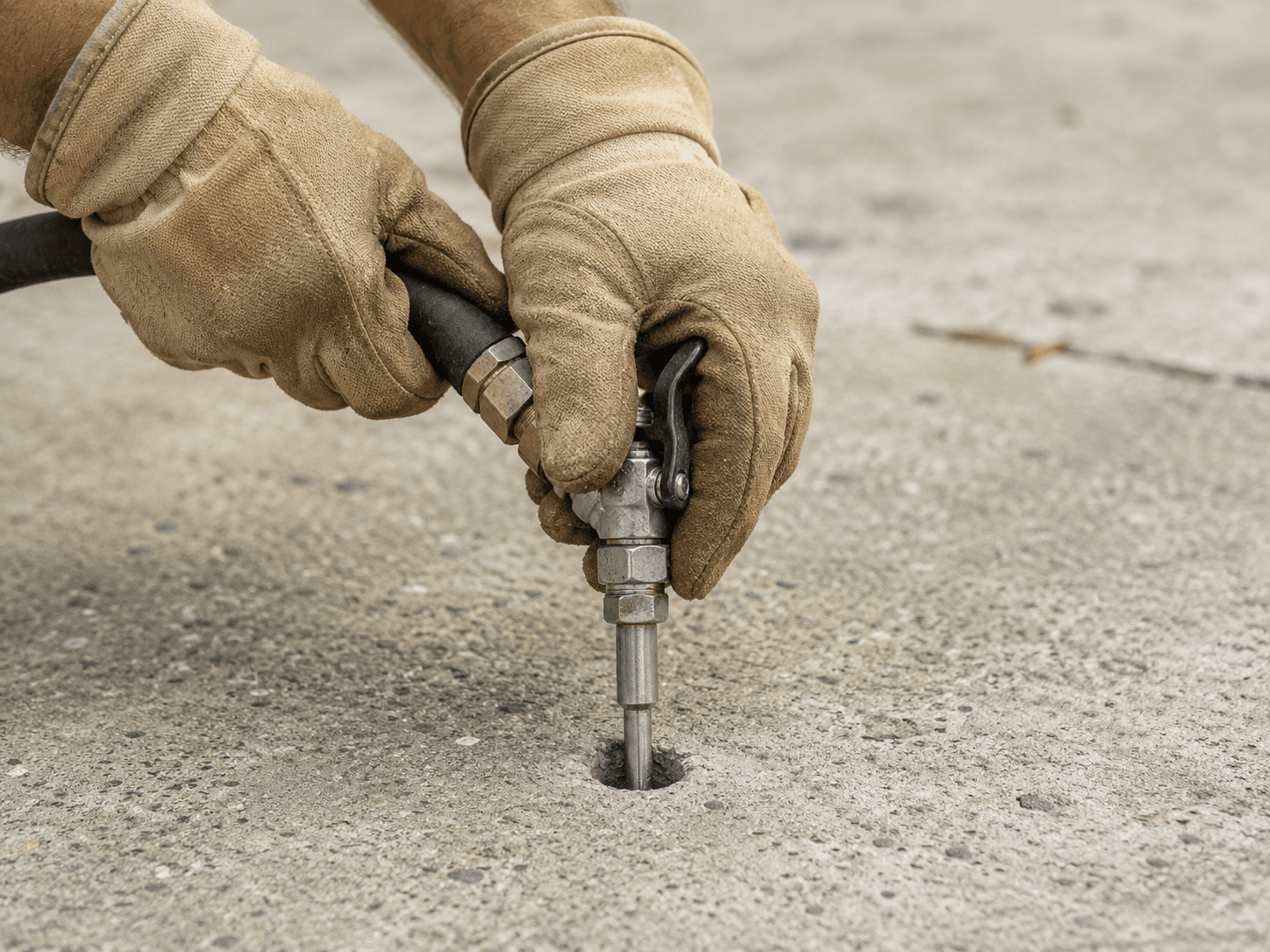
Drilling and injection. Small ports drilled in a calculated pattern. Staged lift to target elevation. Most jobs done in a few hours.
Cure and finish. Ports patched. Polyurethane is structurally loaded within minutes. Cementitious slurry takes longer but is still measured in hours.
HOA documentation when needed. For townhome and condo work, we provide before/after photos, port-pattern documentation, and the kind of paper trail that makes maintenance ledger reconciliation straightforward.
We don't quote slab thickness, rebar gauge, or PSI ratings we can't verify. Structural opinions on a slab we haven't lifted go to a structural engineer.
Plano Neighborhoods We Serve
We work the entire 75024 footprint and the adjacent Plano ZIPs along the Dallas North Tollway and Preston Road corridors. The neighborhoods that show up in the open geographic record include Highlands North, Preston Square, Prestondale, Robin's Place, Turnberry Village, and Wyndemere — a solid spread across west Plano.
The largest single area we get calls from is the Willow Bend community — the west Plano subdivision bounded by the Dallas North Tollway to the west, Preston Road to the east, W Parker Road to the north, and Plano Parkway to the south. Willow Bend was built out across multiple phases starting in the 1980s and continuing through the 2000s, so the housing stock spans the era boundary in our census data. Within and around Willow Bend, smaller subdivisions like Pebble Brook at Willow Bend and Creeks of Willow Bend appear regularly on our schedule.
We also cover the corridor around Legacy West and the modern townhome and condo developments along the Sam Rayburn Tollway. Legacy West is the 240-acre mixed-use anchor at the southwest corner of the Dallas North Tollway and SH 121; the retail-and-residential side opened in June 2017, which means the surrounding multi-family flatwork is now coming up on a decade out from the original pour. That's the early-window part of the curve where settlement around equipment pads, courtyards, and shared walks starts becoming visible against engineered-grade expectations, and we get a steady volume of HOA-routed work in that footprint.
A piece of older Plano context worth flagging: the Heritage Farmstead Museum at 1900 W 15th Street is a working-farm site centered on an 1891 late-Victorian farmhouse, with the surrounding 4.5-acre site listed on the National Register since 1978 and opened to the public as a living museum in 1986. The point isn't the museum itself — the point is that the Plano housing stock has a real pre-war layer underneath the heavy 2000s overlay, and the older streets in the eastern half of the city sit on slabs that don't behave like the post-2000 master-planned stock dominating 75024. We don't see those calls often in the west Plano ZIP, but when we do they're a different conversation.
The principle is the same everywhere: Houston Black at very high shrink-swell, modern slabs that respond well to polyurethane lifting, and a meaningful share of the work coming through HOAs and property managers rather than individual owners.
Plano Concrete Leveling FAQ
How much does concrete leveling cost in Plano? Most jobs run $400 to $3,000. Townhome and HOA scopes can fall outside this range when there's a long ribbon of common-area sidewalk or a large shared patio involved. We quote on-site after we've seen the work.
Mudjacking or polyjacking on Houston Black clay? For most residential and HOA Plano work, polyurethane is the default. The closed-cell foam is light — it doesn't add weight that the swelling clay can later push back into the slab — and it cures fast enough that you can use the surface the same day. Mudjacking still has a place on very large slabs.
My townhome has a cracked common-area sidewalk. Who do I call first — you or the HOA? Talk to your HOA first. Common-area flatwork is almost always HOA-maintained, and the HOA needs to be the one to commission and approve the work. We can speak directly with the HOA's property manager once they've authorized us to scope.
My house was built in 2001. Why is the patio settling now? Twenty-plus years of wet-dry cycling on Houston Black is exactly when settlement-driven flatwork problems become visible. Modern post-2000 foundations are engineered to handle the clay; the surrounding flatwork was usually poured to a lighter spec on the same reactive subgrade. Year 20-25 is when the disparity catches up.
How long does the lift hold on shrink-swell soil? A clean polyurethane lift on a sound slab typically holds for many years. The clay keeps cycling, but the foam is closed-cell and doesn't compress under residential loads. Failures are usually traceable to the slab itself being cracked through rather than to the lift wearing out.
Can lifting fix a slab that's badly cracked? Lifting can only re-support a slab that's structurally sound. If the concrete itself is cracked through, lifting isn't the right scope — partial removal and re-pour, or full replacement, is. We tell you which one on the on-site visit.
Will lifting affect the foundation of my home? No. Flatwork lifting addresses concrete that sits on grade — driveways, sidewalks, patios, pool decks, A/C pads. It doesn't touch the foundation slab itself. If we suspect foundation involvement, we'll point you to a foundation specialist.
Do you handle HOA and property-manager work? Yes. A meaningful share of our 75024 work comes through HOAs and property managers. We provide itemized quotes, before/after documentation, and the paper trail that fits maintenance-ledger workflows.
What's the earliest visible warning sign on Plano slabs? A gap opening at a control joint where the driveway meets the garage apron, or a hairline crack running from a corner of the back patio. By the time you can fit a quarter under any slab edge, you're firmly in the actionable range — that's the call to make before the next dry summer compounds it.
Talk it through with someone who works Plano.
Describe what you're seeing — a crack, a sunken slab, a foundation question, a new pour. We'll tell you what it likely is and what it costs to fix.
Call (682) 254-4938